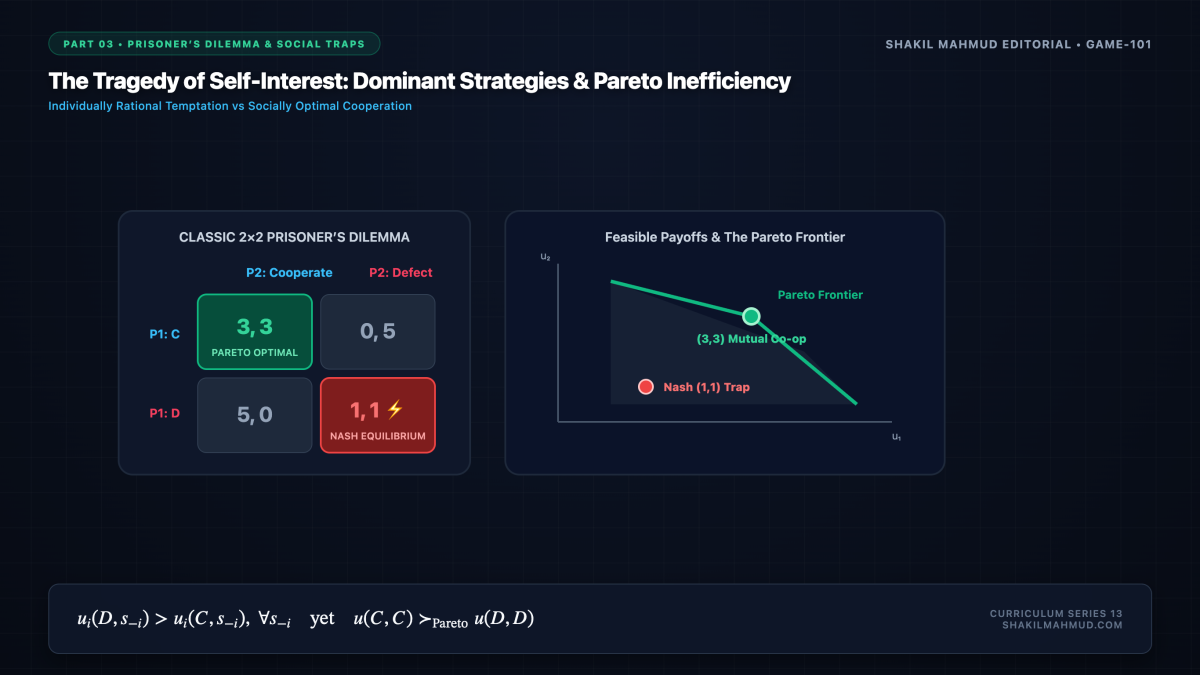
In 1950, at the RAND Corporation in Santa Monica, mathematicians Merrill Flood and Melvin Dresher were experimenting with simple 2×2 payoff matrices to model strategic nuclear bargaining between the United States and the Soviet Union. When Albert Tucker subsequently framed the mathematical dilemma through the narrative of two interrogated criminal suspects facing jail time, the paradox entered the global lexicon as The Prisoner’s Dilemma. It remains the most widely analyzed strategic problem in human history: a stark demonstration that when individuals act with unimpeachable private rationality, the inescapable outcome can be collective ruin.
The Anatomy of the Dilemma
Two suspects are arrested and held in separate interrogation cells with zero communication. The prosecutor offers each prisoner the identical bargain:
- If Prisoner 1 defects ($D$) and implicates Prisoner 2 while Prisoner 2 remains silent ($C$), Prisoner 1 walks free ($0$ years) while Prisoner 2 serves a harsh $5$-year sentence.
- If both prisoners cooperate ($C$) and stay silent, both serve a minor sentence of $1$ year on a lesser charge.
- If both defect ($D$) and betray each other, both serve $3$ years.
The formal payoff matrix satisfies the classic condition: $T > R > P > S$, where $T = 0$ (Temptation to defect), $R = -1$ (Reward for mutual cooperation), $P = -3$ (Punishment for mutual defection), and $S = -5$ (Sucker’s payoff). Furthermore, to prevent exploitation under alternation, $2R > T + S$.
Strict Dominance & The Nash Trap
Let us analyze Prisoner 1’s decision matrix:
- If Prisoner 2 stays silent ($C$), Prisoner 1 compares $-1$ (Cooperate) against $0$ (Defect). Defecting yields freedom ($0 > -1$).
- If Prisoner 2 betrays ($D$), Prisoner 1 compares $-5$ (Cooperate) against $-3$ (Defect). Defecting saves two years of prison ($-3 > -5$).
Regardless of what Prisoner 2 chooses, Defect strictly dominates Cooperate: $u_1(D, s_2) > u_1(C, s_2)$ for all $s_2 in {C, D}$. By identical symmetry, Defection strictly dominates for Prisoner 2. Thus, the unique Nash Equilibrium, reached by iterated elimination of strictly dominated strategies, is:
$$sigma^* = (D, D) implies text{Payoff: } (-3, -3)$$
Yet if both prisoners had stayed silent, each would have served only $1$ year ($(-1, -1)$). The outcome $(-1, -1)$ strictly Pareto dominates $(-3, -3)$ because both agents would be simultaneously better off. Individual rationality leads systematically to social suboptimality.
Social Dilemmas & The Tragedy of the Commons
The Prisoner’s Dilemma is not a curious puzzle; it is the mathematical archetype of all systemic social failures. When generalized to $N$ agents, it generates Garrett Hardin’s Tragedy of the Commons (1968):
- Overfishing & Ecological Collapse: Every commercial fishing vessel captures private marginal revenue by catching one more ton of tuna, while the biological depletion cost is dispersed across the entire global commons. Dominant strategy: overfish to extinction.
- Anthropogenic Climate Change: Every nation benefits privately from burning fossil fuels to power industrial growth, while atmospheric carbon accumulation creates a planetary externality. Dominant strategy: emit carbon without restraint.
- Nuclear Arms Races: In a bilateral cold war, arming is a strictly dominant strategy against an opponent who might arm, locking both superpowers into multi-trillion-dollar arsenals with zero net security improvement.
Escaping the Dilemma: Mechanisms & External Enforcers
In a one-shot Prisoner’s Dilemma with zero external enforcement, no rational player can ever cooperate. Cooperation requires altering the game’s mathematical architecture:
- Third-Party Enforcement (Hobbesian Leviathan): A state or legal framework imposes severe penalties $tau > T – R$ on defection, transforming the payoffs such that cooperation becomes the dominant strategy.
- Binding Smart Contracts: On cryptographic networks, escrow deposits and algorithmic slashing conditions make unilateral defection mathematically impossible.
- Repetition & The Shadow of the Future: As we explore in Part 5, when the interaction is repeated indefinitely, the threat of future retaliation can sustain mutual cooperation without any central authority.