In simultaneous-move games, agents commit their strategies blindly, shielded by the fog of war. But the vast majority of real-world conflicts unfold sequentially across time: a technology giant invests in a new computing standard, after which rivals choose whether to adopt or resist; an aggressor state demands territory, after which the defender decides whether to concede or wage war. In sequential decision-making, timing is everything. In 1965, the German Nobel laureate Reinhard Selten identified a fundamental pathology at the heart of ordinary game theory: the plague of incredible threats. To cure it, Selten invented the concept of Subgame Perfect Equilibrium.
The Extensive Form & Game Trees
An extensive-form game formalizes sequential interaction as a directed tree $Gamma = (V, E, P, H, u)$:
- Nodes ($V$): Decision nodes where specific players make choices, beginning at root node $x_0$.
- Branches ($E$): Actions available to the player at that node.
- Information Sets ($H$): Partitions of decision nodes. If an information set contains more than one node, the player cannot distinguish which specific history occurred (imperfect information). If every information set is a singleton, the game has perfect information.
- Terminal Nodes & Payoffs ($u$): Leaves of the tree where the interaction concludes and payoff vectors $(u_1, dots, u_n)$ are distributed.
The Market Entry Game: The Flaw of Ordinary Nash
Consider a classic strategic scenario: a Challenger firm considers entering a market dominated by an Incumbent monopolist.
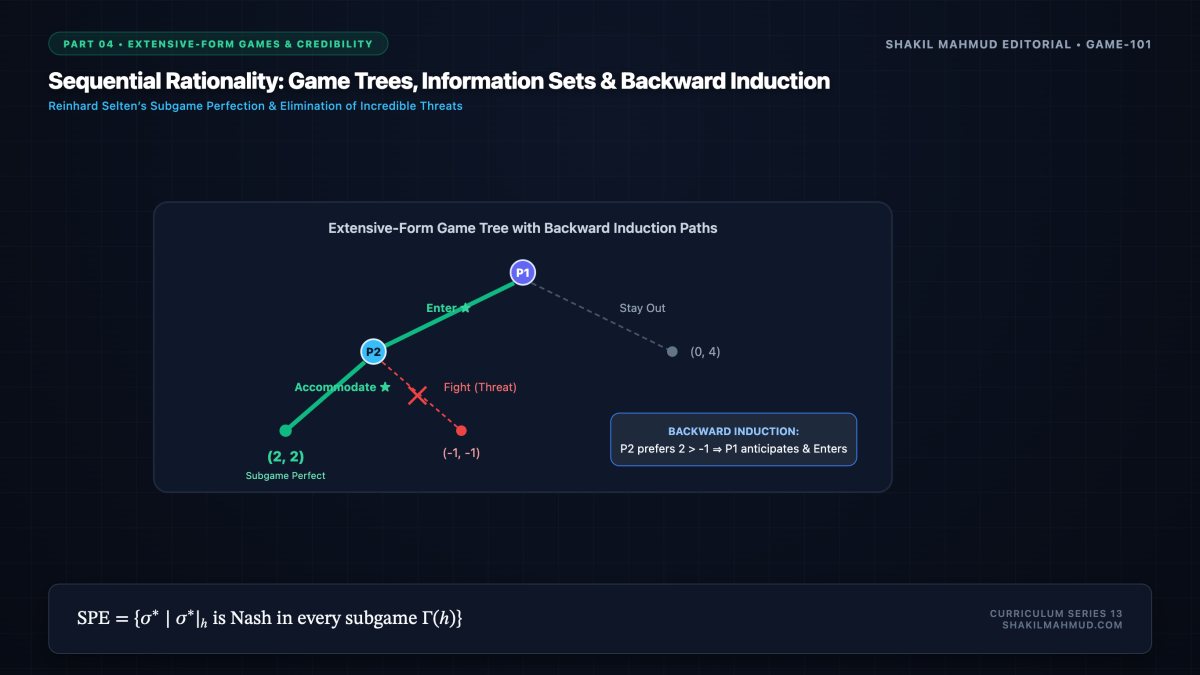
- Challenger moves first: choose Enter or Stay Out. If Challenger stays out, the game ends with payoffs $(0, 4)$ (Challenger earns $0$, Incumbent earns monopoly profits $4$).
- If Challenger enters, the Incumbent observes the entry and chooses: Accommodate (share the market) or Fight (initiate an aggressive predatory price war).
- If Incumbent accommodates, payoffs are $(2, 2)$. If Incumbent fights, both suffer severe losses: $(-1, -1)$.
When converted to standard normal form, this game contains two distinct Nash Equilibria:
- Equilibrium 1: (Enter, Accommodate) $implies$ Payoffs: $(2, 2)$.
- Equilibrium 2: (Stay Out, Fight) $implies$ Payoffs: $(0, 4)$.
Examine Equilibrium 2 carefully. The Incumbent threatens: “If you dare enter my market, I will fight a price war to the death!” If the Challenger believes this threat, staying out is indeed a best response ($0 > -1$). And given that the Challenger stays out, the Incumbent’s threat of fighting is never tested on the equilibrium path, so any action at that unreached node technically satisfies the static Nash definition.
Yet Equilibrium 2 is absurd. Suppose the Challenger calls the bluff and enters. The Incumbent now stands at the decision node comparing $2$ (Accommodate) against $-1$ (Fight). Fighting is completely irrational; destroying one’s own capital to punish a fait accompli is self-harm. The threat to fight is an incredible threat.
Backward Induction & Subgame Perfection
Reinhard Selten realized that an equilibrium must be robust not just at the root, but in every conceivable continuation of play. A subgame $Gamma(x)$ is a portion of the extensive game tree that begins at a singleton node $x$, includes all its successors, and does not fracture any player’s information sets.
A strategy profile $sigma^*$ is a Subgame Perfect Equilibrium (SPE) if it induces a Nash equilibrium in every proper subgame of the overall tree:
$$sigma^*|_h in text{Nash}(Gamma(h)), quad forall h in H$$
In finite games of perfect information, the SPE is computed via Backward Induction:
- Go to the penultimate decision nodes immediately preceding the terminal leaves.
- Determine the utility-maximizing action for the acting player and prune all inferior branches.
- Replace the decision node with the optimal payoff vector and step backward up the tree toward the root.
- Repeat iteratively until the entire tree is solved.
Applying backward induction to the Market Entry game: at the Incumbent’s subgame, $2 > -1$, so the Incumbent strictly chooses Accommodate. The Challenger looks ahead, anticipates that the Incumbent will accommodate, and compares $2$ (Enter) against $0$ (Stay Out). The Challenger enters. The unique Subgame Perfect Equilibrium is (Enter, Accommodate). The incredible threat is mathematically eradicated.
Strategic power does not derive from making terrifying threats; it derives from structuring commitments such that carrying out the threat becomes self-interested when the moment of crisis arrives. Unenforceable threats carry zero weight against rational adversaries.