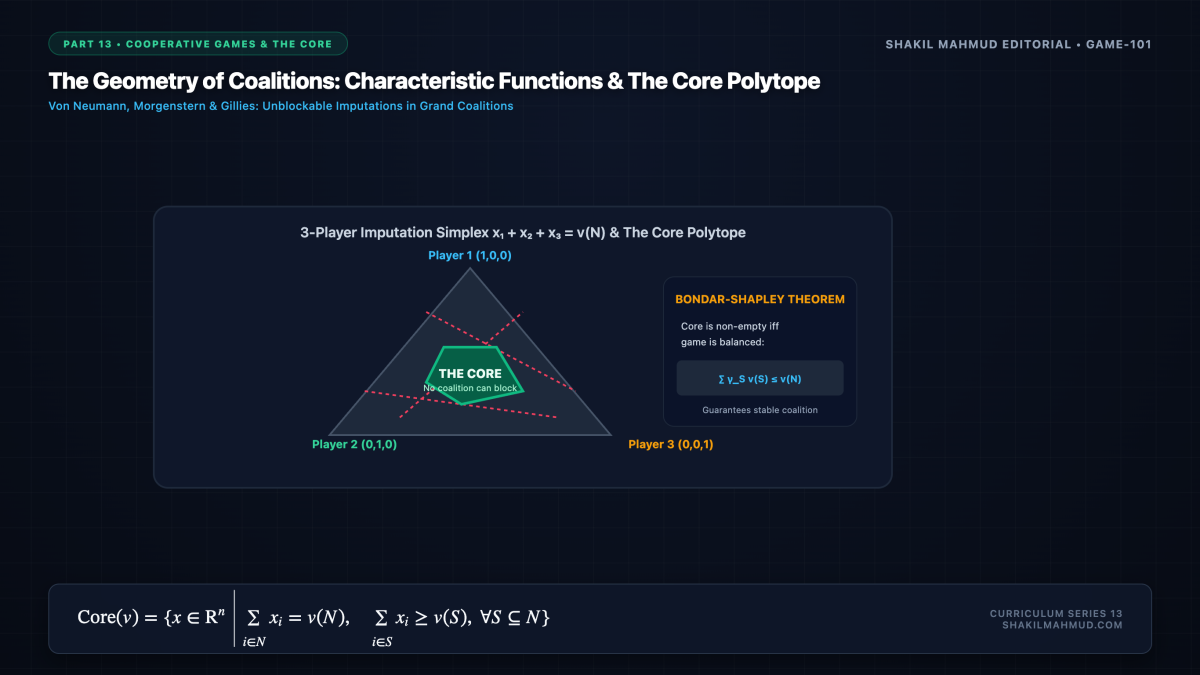
In non-cooperative game theory, individual agents duel in isolation, unable to forge binding agreements. But throughout economic and political history, agents form cartels, unions, alliances, and sovereign federations: OPEC coordinates petroleum output; nations enter mutual defense pacts (NATO); companies form corporate syndicates. When players can sign legally or algorithmically binding commitments, the strategic problem fundamentally shifts: How should the collective wealth produced by a coalition be distributed so that no subset of players has an incentive to secede? This is the domain of Cooperative Game Theory and the geometry of The Core.
Characteristic Function Form & Transferable Utility
A cooperative game with transferable utility (TU) is defined by a pair $(N, v)$, where $N = {1, dots, n}$ is the finite set of players and $v: 2^N to mathbb{R}$ is the characteristic function. For every coalition subset $S subseteq N$, the scalar $v(S)$ represents the total economic payoff that members of $S$ can create entirely on their own, with $v(emptyset) = 0$.
Most economic settings exhibit superadditivity: the whole is greater than or equal to the sum of its parts. If two disjoint coalitions merge, their joint output cannot decrease:
$$v(S cup T) ge v(S) + v(T), quad forall S, T subseteq N text{ with } S cap T = emptyset$$
Superadditivity guarantees that forming the grand coalition $N$ maximizes total societal wealth ($v(N)$). The central question becomes: how do we divide the pie?
Imputation Space & The Core Defined
An allocation vector $x = (x_1, dots, x_n) in mathbb{R}^n$ assigns payoff $x_i$ to player $i$. An allocation is an imputation if it is:
- Efficient: $sum_{i in N} x_i = v(N)$ (the entire grand coalition value is distributed).
- Individually Rational: $x_i ge v({i})$ for all $i in N$ (every player receives at least what they can achieve alone).
However, individual rationality is not enough. What if a subset of players $S subset N$ realizes that by breaking away and forming their own breakaway coalition, they can generate $v(S)$ which exceeds their proposed sum of payoffs $sum_{i in S} x_i$? Coalition $S$ will veto the agreement and block the allocation.
The Core of a cooperative game is the set of all allocations that cannot be blocked by any coalition whatsoever:
$$text{Core}(v) = left{ x in mathbb{R}^n ;middle|; sum_{i in N} x_i = v(N) quad text{and} quad sum_{i in S} x_i ge v(S), ; forall S subseteq N right}$$
Geometrically, the Core is a convex polyhedron in the $(n-1)$-dimensional imputation simplex defined by the intersection of $2^n – 2$ linear inequality half-spaces. An allocation in the Core represents an unassailable political and economic settlement: no splinter group can credibly threaten to walk away.
The Bondareva-Shapley Theorem: When is the Core Non-Empty?
Does a stable Core allocation always exist? Astonishingly, the answer is no. In a simple majority voting game with 3 players dividing $$100$ ($v(S) = 100$ if $|S| ge 2$, $v(S) = 0$ otherwise), the Core is completely empty! Any proposed distribution $(50, 50, 0)$ is immediately blocked by players 1 and 3 offering $(75, 0, 25)$, which is in turn blocked by players 2 and 3, in a perpetual cycle of political betrayal.
In 1963, Olga Bondareva (in the USSR) and Lloyd Shapley (in the USA) independently proved the necessary and sufficient condition for the Core to be non-empty. A collection of weights $gamma_S in [0, 1]$ is balanced if for each player $i$, $sum_{S ni i} gamma_S = 1$. The Bondareva-Shapley Theorem states:
$$text{Core}(v) neq emptyset iff sum_{S subseteq N} gamma_S v(S) le v(N) quad text{for all balanced collections } (gamma_S)$$
A game has a non-empty Core if and only if it is balanced. This theorem directly connects coalitional stability to linear programming duality, providing the mathematical bedrock for matching theory, resource pooling, and modern decentralization protocols.