In standard game theory, the rules of the game are carved in stone, and the analyst’s role is to predict how rational agents will behave within those constraints. In Mechanism Design, the arrow of causality is reversed: the desired social outcome is known, and the analyst’s task is to invent the game itself. Mechanism design is the ultimate form of strategic institutional engineering: constructing rules, incentives, and protocols such that self-interested agents, pursuing purely selfish agendas, are guided as if by an invisible mathematical hand to produce a socially optimal outcome. In 1972, Leonid Hurwicz, Eric Maskin, and Roger Myerson laid the cornerstone of this science with one of the most powerful theorems in mathematical economics: The Revelation Principle.
The Mechanism Design Problem
Consider a designer who wishes to choose a social alternative $x in X$ (such as building a public bridge, allocating radio spectrum, or matching kidney donors). There are $n$ agents, each possessing a private preference or type $theta_i in Theta_i$. An agent’s utility is $u_i(x, theta_i)$.
The designer has an overarching objective codified as a Social Choice Function $f: Theta to X$, mapping state profiles $theta = (theta_1, dots, theta_n)$ into socially desired outcomes $f(theta)$. But the designer faces a fatal obstacle: the designer does not know the true types $theta$! The designer cannot read minds. If the designer naively asks agents to report their valuations, agents have every incentive to distort, exaggerate, or conceal their preferences.
Indirect Mechanisms & Strategic Complexity
To overcome this, an institutional designer creates an indirect mechanism $mathcal{M} = ((M_i)_{i in N}, g)$:
- Each agent $i$ is assigned a complex message space $M_i$ (bids, proposals, multi-round counter-offers, or cryptographic proof commitments).
- An outcome rule $g: M_1 times dots times M_n to X$ determines the physical outcome based on submitted messages.
Agents play a Bayesian game on $mathcal{M}$. If $s_i^*(theta_i)$ represents agent $i$’s equilibrium strategy, the mechanism successfully implements the social choice function $f$ if the equilibrium outcome matches the social goal for all type profiles:
$$g(s_1^*(theta_1), dots, s_n^*(theta_n)) = f(theta_1, dots, theta_n), quad forall theta in Theta$$
Designing an indirect mechanism appears to be an impossible task: there are infinite conceivable message spaces, infinite auction formats, and infinite complex bargaining procedures. How can a designer ever know they have found the optimal one?
The Revelation Principle
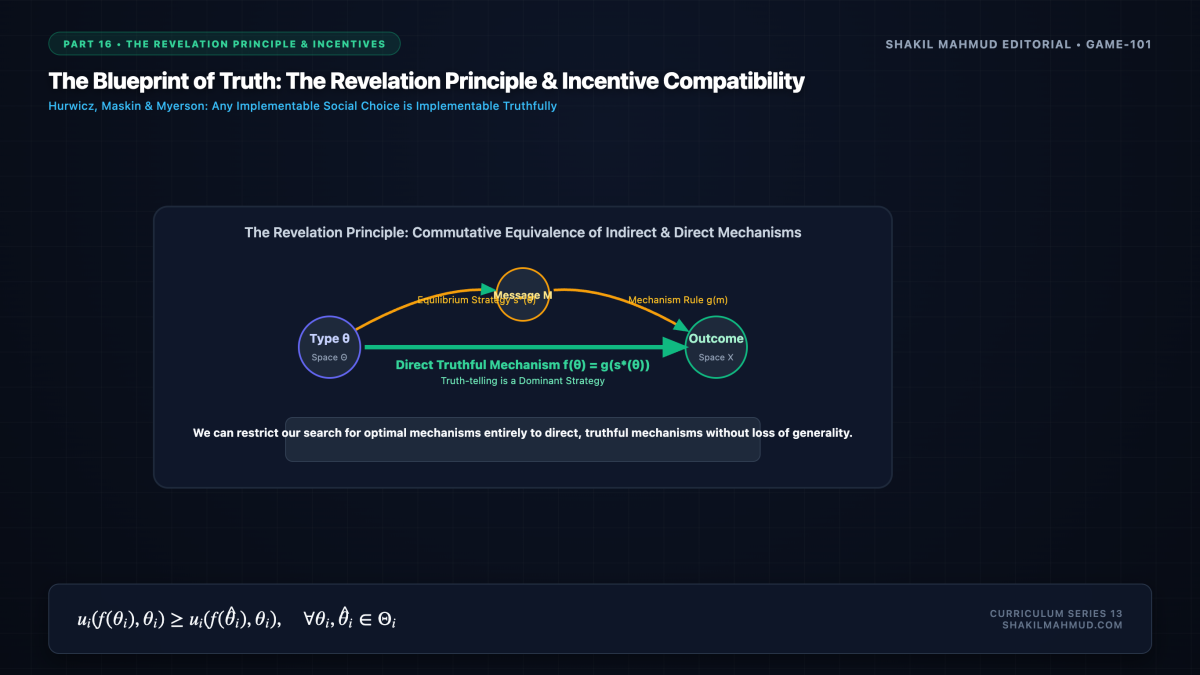
In 1979, Roger Myerson, building on insights by Leonid Hurwicz and Partha Dasgupta, proved a result of astonishing elegance. A direct-revelation mechanism is one in which the message space is simply the type space itself ($M_i = Theta_i$): agents are asked to report their private types directly ($hat{theta}_i$). A direct mechanism is Incentive Compatible (Strategyproof) if truth-telling is an equilibrium.
If any social choice function $f$ can be implemented by any indirect mechanism $mathcal{M}$ (no matter how complex, multi-stage, or convoluted) in Bayesian (or dominant-strategy) equilibrium, then $f$ can also be implemented by a direct-revelation mechanism in which truth-telling is an equilibrium.
The Commutative Proof
The proof is a masterpiece of mathematical simplicity:
- Suppose there exists an indirect mechanism with equilibrium strategies $s^*(theta) = (s_1^*(theta_1), dots, s_n^*(theta_n))$ producing outcome $g(s^*(theta)) = f(theta)$.
- Construct a new, automated direct mechanism: tell the agents, “Do not worry about calculating complex bids. Just tell me your true type $theta_i$. My computer software will simulate your equilibrium strategy $s_i^*(theta_i)$ for you, feed it into the old mechanism $g$, and give you the resulting outcome!”
- Can any agent benefit from lying to the computer and reporting a false type $hat{theta}_i$? No! Because lying to the computer is mathematically identical to choosing the strategy $s_i^*(hat{theta}_i)$ in the original mechanism. Since $s_i^*(theta_i)$ was already an equilibrium best-response in the original game, submitting a dishonest type cannot increase the agent’s payoff!
Truth-telling is automatically incentive-compatible: $u_i(f(theta_i, theta_{-i}), theta_i) ge u_i(f(hat{theta}_i, theta_{-i}), theta_i)$.
The Practical Power: Restricting the Search Space
The Revelation Principle completely transformed economics and mechanism design. Instead of searching across the terrifying, infinite universe of all possible indirect games, contracts, and auction rules, we can restrict our mathematical optimization entirely to direct mechanisms where truth-telling is an explicit constraint! This single theorem opened the floodgates to modern auction theory, public goods provision, carbon credit markets, and blockchain consensus design.