Throughout the history of mathematics, algebra, geometry, and analysis developed as separate continental plates, each with its own language and intuition. In 1967, in a 17-page handwritten letter to André Weil, Robert Langlands outlined a revolutionary vision that would become modern mathematics’ most ambitious endeavor: The Langlands Program. Frequently hailed as a “Grand Unified Theory of Mathematics,” this sprawling network of conjectures establishes a cosmic bridge connecting the non-abelian symmetries of arithmetic with the harmonic analysis of symmetric spaces.
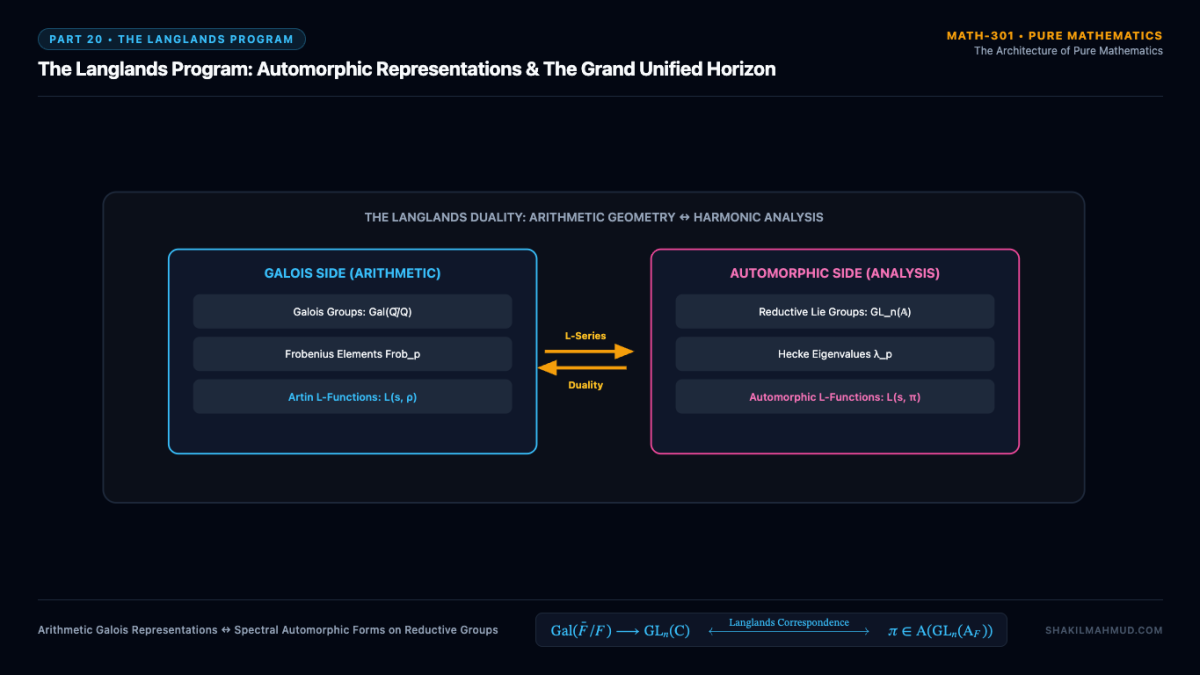
1. The Arithmetic Pole: The Absolute Galois Group $G_mathbb{Q}$
In Galois theory, polynomial symmetries are governed by Galois groups. Over the field of rational numbers $mathbb{Q}$, adjoining all algebraic numbers generates the algebraic closure $overline{mathbb{Q}}$. The symmetries of this infinite universe are encoded in the Absolute Galois Group:
G_mathbb{Q} equiv text{Gal}(overline{mathbb{Q}}/mathbb{Q})
Endowed with the Krull profinite topology, $G_mathbb{Q}$ is an unfathomably vast and chaotic group. One of the primary goals of algebraic number theory is to understand its continuous finite-dimensional representations into general linear groups over $p$-adic or complex numbers:
rho: G_mathbb{Q} longrightarrow text{GL}(n, mathbb{C}) quad text{or} quad rho: G_mathbb{Q} longrightarrow text{GL}(n, mathbb{Q}_ell)
When $n = 1$ (abelian representations), class field theory (developed by Gauss, Kummer, Hilbert, and Artin) completely solved this via Artin Reciprocity, proving that 1D Galois representations match Dirichlet characters. For $n ge 2$, non-abelian Galois representations remained an impenetrable frontier.
2. The Analytic Pole: Automorphic Representations & Adeles
On the opposite side of the mathematical cosmos lies Harmonic Analysis on reductive Lie groups. By unifying the real numbers $mathbb{R}$ with all $p$-adic number fields $mathbb{Q}_p$ into the ring of Adeles $mathbb{A}_mathbb{Q}$, mathematicians study harmonic analysis globally across all primes simultaneously.
An Automorphic Form on $text{GL}(n)$ is a generalized modular form living on the symmetric quotient space $text{GL}(n, mathbb{Q}) backslash text{GL}(n, mathbb{A}_mathbb{Q})$. These forms generate irreducible Automorphic Representations $pi = bigotimes_v pi_v$, which are spectral eigenfunctions of the invariant differential operators (Casimir operators) and Hecke algebras.
3. The Langlands Reciprocity Conjecture
Langlands postulated a profound, bijective correspondence between these two disparate worlds: Reciprocity.
For every continuous, irreducible $n$-dimensional Galois representation $rho: G_mathbb{Q} to text{GL}(n, mathbb{C})$, there exists a unique cuspidal automorphic representation $pi$ of $text{GL}(n, mathbb{A}_mathbb{Q})$ such that their $L$-functions match identically Euler factor by Euler factor:
L(s, rho) = L(s, pi)
This correspondence translates baffling questions about prime numbers and algebraic equations (roots of polynomials modulo $p$) into questions about harmonic waves and spectral analysis on Lie groups. Andrew Wiles’ proof of Fermat’s Last Theorem was the proof of Langlands Reciprocity for $n=2$ over $mathbb{Q}$!
4. The Geometric Langlands Correspondence & The Horizon
For general reductive algebraic groups $G$ (such as $text{SO}(n)$, $text{Sp}(2n)$, or exceptional groups $E_8$), Langlands introduced the Dual Group $^L G$ (the Langlands dual, where roots and coroots are swapped). The conjecture posits that automorphic representations of $G$ correspond to homomorphisms from Galois/Weil groups into $^L G$.
In recent decades, Alexander Beilinson, Vladimir Drinfeld, and Edward Witten expanded this framework into the Geometric Langlands Correspondence. Replacing number fields with algebraic curves over $mathbb{C}$ or finite fields, geometric Langlands establishes an equivalence between derived categories of coherent sheaves on flat $^L G$-bundles and D-modules (Hecke eigensheaves) on the moduli stack of $G$-bundles:
Dtext{-Mod}(text{Bun}_G) cong text{QCoh}(text{LocSys}_{^L G})
In 2024, a monumental multi-thousand-page proof of the unramified Geometric Langlands Conjecture was completed by Gaitsgory and collaborators. Concurrently, Witten demonstrated that geometric Langlands is the mathematical manifestation of S-duality and Montonen-Olive electric-magnetic duality in 4D supersymmetric Yang-Mills gauge theory.
From set-theoretic axioms to the Langlands duality, pure mathematics emerges not as a collection of isolated disciplines, but as a singular, harmonious cathedral of truth—an eternal architecture reflecting the deep, intelligible logic of the universe.