Around $2.7text{ Ma}$, the African climate experienced severe aridification, driven by global orbital cooling cycles and the onset of Northern Hemisphere glaciation. In response to the fragmentation of closed forest canopies and the explosive expansion of open, seasonal grasslands, the hominin lineage split into two sharply divergent evolutionary trajectories: the gracile line that gave rise to the tool-making, broad-diet genus Homo, and a specialized lineage of hyper-robust chewing machines belonging to the genus Paranthropus.
1. The Robust Clade: Discovery and Hypodigm
The robust australopithecines (often classified as a distinct genus, Paranthropus, meaning “beside human”) comprise three recognized species spanning eastern and southern Africa:
- Paranthropus aethiopicus ($2.7text{–}2.3text{ Ma}$): Exemplified by the famed “Black Skull” (KNM-WT 17000) from West Turkana, Kenya, stained dark by manganese minerals. With an endocranial volume of $410text{ cm}^3$ and an enormous sagittal crest, it represents the stem morphotype of the robust radiation.
- Paranthropus boisei ($2.3text{–}1.2text{ Ma}$): Discovered by Mary Leakey in 1959 at Olduvai Gorge, Tanzania (specimen OH 5, initially named Zinjanthropus boisei or “Nutcracker Man”). It represents the extreme pinnacle of hominin craniofacial robusticity.
- Paranthropus robustus ($2.0text{–}1.2text{ Ma}$): The southern African representative discovered by Robert Broom at Kromdraai and Swartkrans.
2. The Biomechanical Engine of Post-Canine Megadontia
The cranium of Paranthropus was an engineering marvel optimized for the generation and dissipation of colossal occlusal bite forces. Rather than expanding brain tissue, natural selection channeled energetic resources into an unprecedented masticatory apparatus:
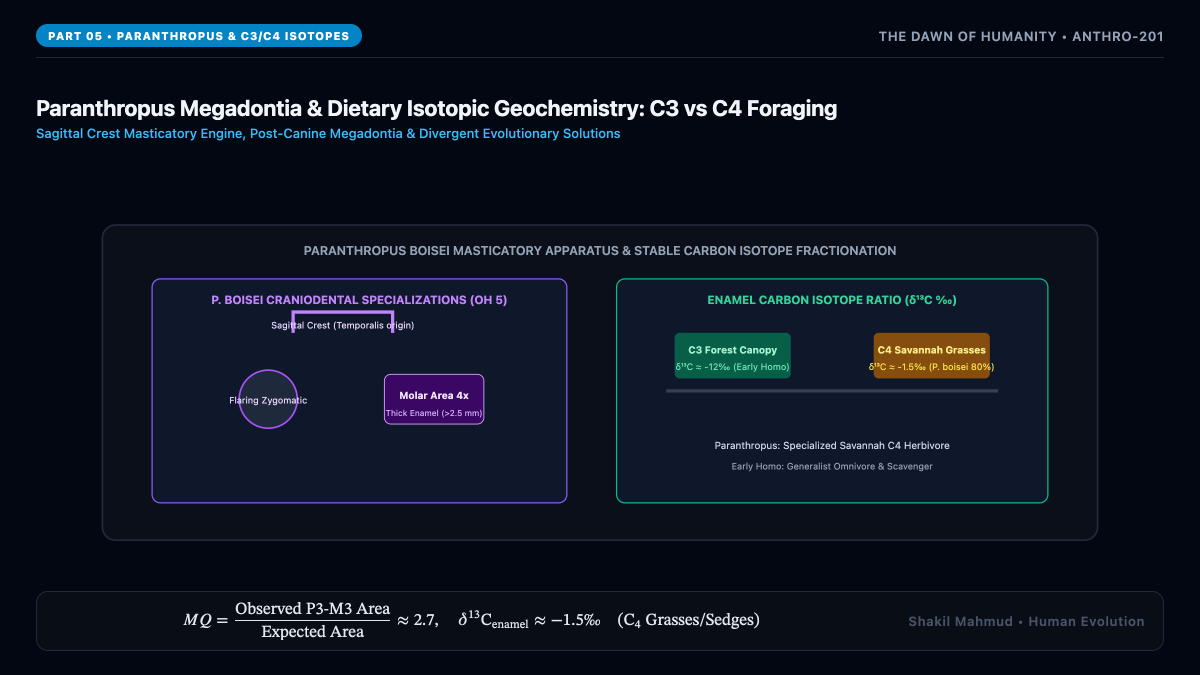
- Sagittal and Nuchal Crests: A prominent bony ridge running along the midline of the calvaria providing an enlarged origin site for the temporalis muscle, allowing the posterior muscle fibers to exert perpendicular crushing forces on the molars.
- Flaring Zygomatic Arches: The cheekbones bow outward anteriorly, creating an enormous subzygomatic fossa through which huge temporalis and masseter muscle bellies passed, while shifting the masseter’s line of action forward directly over the premolars.
- Dished Facial Profile: The midface is deeply concave with post-orbital constriction, positioning the bite plane close to the muscular levers to maximize mechanical advantage ($MA = frac{text{Effort Arm}}{text{Load Arm}}$).
The dental specialization is quantified by the Megadontia Quotient (MQ), which measures post-canine tooth surface area relative to body mass:
$$MQ = frac{text{Observed Area of } (P_3 – M_3)}{text{Expected Area for Primate Body Mass}}$$
While modern humans possess an $MQ approx 0.9$ and early Homo exhibits $MQ approx 1.7$, Paranthropus boisei reaches an astonishing:
$$MQ_{text{boisei}} approx 2.7$$
Its molars were four times the surface area of modern humans, capped with enamel shields exceeding $2.5text{ mm}$ in thickness, designed to withstand continuous crushing of abrasive particles without catastrophic crown fracture.
3. Stable Isotope Geochemistry: Shattering the “Nutcracker” Paradigm
For half a century, P. boisei was assumed to have consumed hard nuts, seeds, and tough fruit rinds—hence the moniker “Nutcracker Man.” In 2011, Thure Cerling and colleagues conducted groundbreaking stable carbon isotope analysis ($delta^{13}text{C}$) on dental enamel from $22$ P. boisei individuals from Kenya.
Plants utilize two distinct photosynthetic pathways that fractionate atmospheric carbon ($^{13}text{C}/^{12}text{C}$) differently:
- $C_3$ Pathway (Calvin Cycle): Utilized by trees, shrubs, and forest fruits, yielding strongly negative enamel signatures ($delta^{13}text{C} approx -14text{ to } -10‰$).
- $C_4$ Pathway (Hatch-Slack Cycle): Utilized by tropical grasses, sedges, and reeds, yielding enriched enamel values ($delta^{13}text{C} approx -3text{ to } +1‰$).
The isotopic ratio is calculated relative to the Vienna Pee Dee Belemnite (VPDB) standard:
$$delta^{13}text{C} = left( frac{(^{13}text{C}/^{12}text{C})_{text{sample}}}{(^{13}text{C}/^{12}text{C})_{text{standard}}} – 1 right) times 1000‰$$
The results were revolutionary: Paranthropus boisei exhibited an enamel $delta^{13}text{C}$ mean of $-1.5‰$, proving that between $75%$ and $80%$ of its entire diet was composed of $C_4$ biomass—tropical grasses, sedges, and underground storage organs (corms and tubers). Rather than cracking nuts in the canopy, Paranthropus was a high-volume grazer of savannah wetlands, processing immense volumes of low-quality cellulose fiber.
4. The Divergent Fate: Specialist Extinction vs Generalist Survival
The evolutionary divergence between Paranthropus and Homo represents a classic ecological case study in specialization versus generalization. For 1.5 million years, Paranthropus flourished alongside early Homo. However, when Middle Pleistocene climate oscillations triggered rapid arid cycles that desiccated wetlands, the hyperspecialized dental machinery of Paranthropus could not adapt. By $1.2text{ Ma}$, Paranthropus vanished from the fossil record, while the tool-using, meat-eating, culturally flexible genus Homo survived to colonize the Old World.