For hundreds of thousands of years, hominins manufactured stone tools that were masterpieces of functional symmetry, yet their minds remained tethered to the physical immediacy of the concrete world. Then, in the Middle Stone Age of Africa, a spark ignited. Humans began etching geometric patterns into red mineral pigments, perforating marine shells to wear as personal jewelry, and projecting mental imagery onto the dark canvas of subterranean limestone caves. This was the Cognitive Revolution—the awakening of symbolic semiotics, synthetic language, and behavioral modernity.
1. Dismantling the “Upper Paleolithic Human Revolution” Myth
For decades, Eurocentric archaeology championed the “Human Revolution” hypothesis (Mellars & Stringer), which claimed that modern human behavior exploded suddenly in Europe around $40,000text{ years ago}$ (the Aurignacian transition), driven by a putative macromutation that rewired the brain for syntax. However, excavations in southern and northern Africa over the past two decades proved that symbolic behavioral modernity was born tens of thousands of years earlier within the African Middle Stone Age (MSA).
2. Blombos Cave: The Symbolic Workshop ($100text{–}75text{ ka}$)
Perched on a wave-swept cliff on the southern coast of South Africa, Blombos Cave, excavated by Christopher Henshilwood, revolutionized the timeline of human cognition:
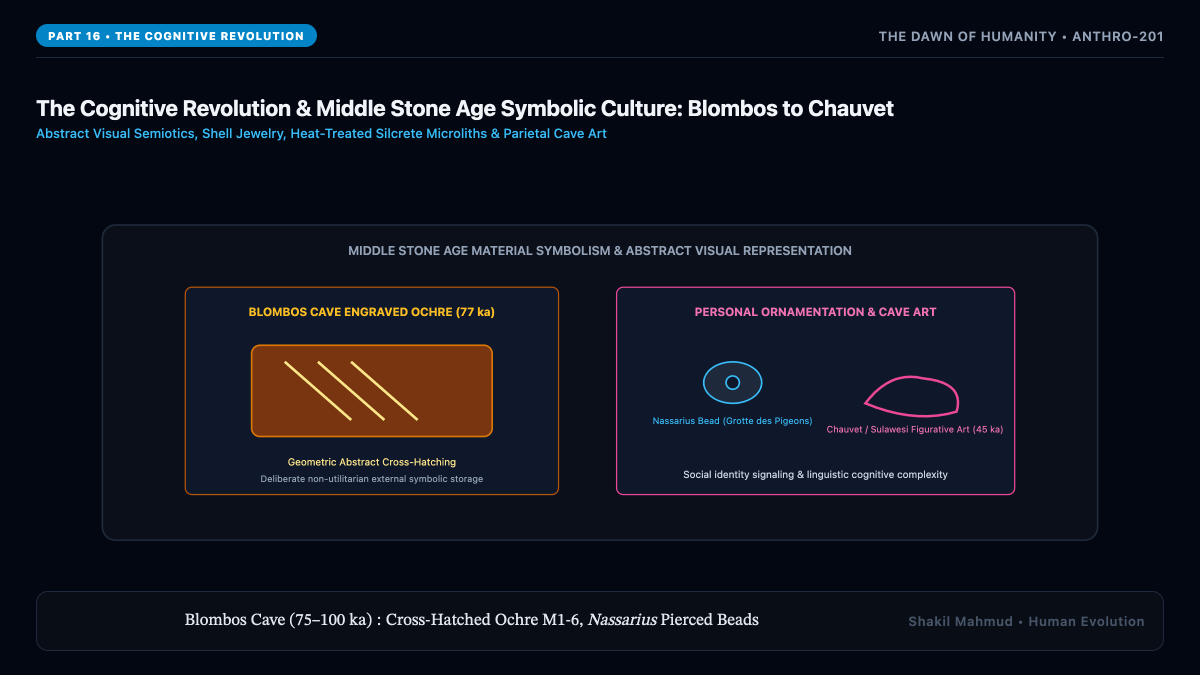
- Engraved Ochre Plaque M1-6 ($77text{ ka}$): A piece of iron-oxide-rich red ochre ground flat and incised with a complex geometric cross-hatched design bounded by parallel carved lines. This represents the world’s oldest unambiguous abstract visual representation—external symbolic storage independent of speech.
- The $100text{-ka}$ Ochre Processing Toolkit: Two abalone shells (Haliotis midae) containing liquefied red ochre compound mixed with ground bone, charcoal, quartz chips, and liquid fat, alongside quartzite grinding stones—proving deliberate chemical compounding of paints for body decoration or ritual.
- Pierced Shell Beads: Deliberately perforated marine tick shells (Nassarius kraussianus) stained with red ochre and exhibiting characteristic wear facets produced by friction against strings and human skin, establishing personal ornamentation as a vehicle for social signaling.
3. Advanced MSA Lithic Pyrotechnology: Still Bay and Howiesons Poort
Alongside symbolic art, MSA hunter-gatherers engineered advanced technologies:
- Heat-Treated Silcrete (Still Bay, $72text{ ka}$): Hominins placed brittle silcrete rock into controlled sand-bath subterranean ovens, holding it at $> 300^circtext{C}$ for over $30text{ hours}$. Thermal treatment altered the mineral matrix, dramatically enhancing flakeability and enabling pressure flaking of delicate bifacial foliate points.
- Geometric Microliths & Composite Arrows (Howiesons Poort, $65text{–}60text{ ka}$): Tiny, razor-sharp backed bladelets (segments and trapezes) bound with plant resin into poisoned bone or wooden projectile arrow tips—the birth of bow-and-arrow technology.
4. The European Climax: Chauvet, Lascaux, and Sulawesi ($45text{–}30text{ ka}$)
When modern humans entered Eurasia, this symbolic capacity reached breathtaking artistic heights:
- Sulawesi, Indonesia ($45.5text{ ka}$): In Leang Tedongnge cave, a figurative painting of a warty pig (Sus celebensis) executed in red ochre, alongside negative hand stencils, proves that figurative cave art was global prior to the European Aurignacian.
- Chauvet Cave (France, $36text{ ka}$): Discovered in 1994, Chauvet preserves hundreds of masterfully shaded, dynamic paintings of dangerous carnivores: lions, woolly mammoths, cave bears, and rhinos, utilizing charcoal blending, perspective, and cave-wall topography to depict motion in subterranean darkness.
- The Hohlenstein-Stadel Löwenmensch ($40text{ ka}$): A $31text{-cm}$ statuette carved from mammoth ivory depicting a human body with a cave lion head—unambiguous archaeological evidence of myth, spiritual imagination, and the mental capacity to conceptualize entities that do not exist in the physical world.