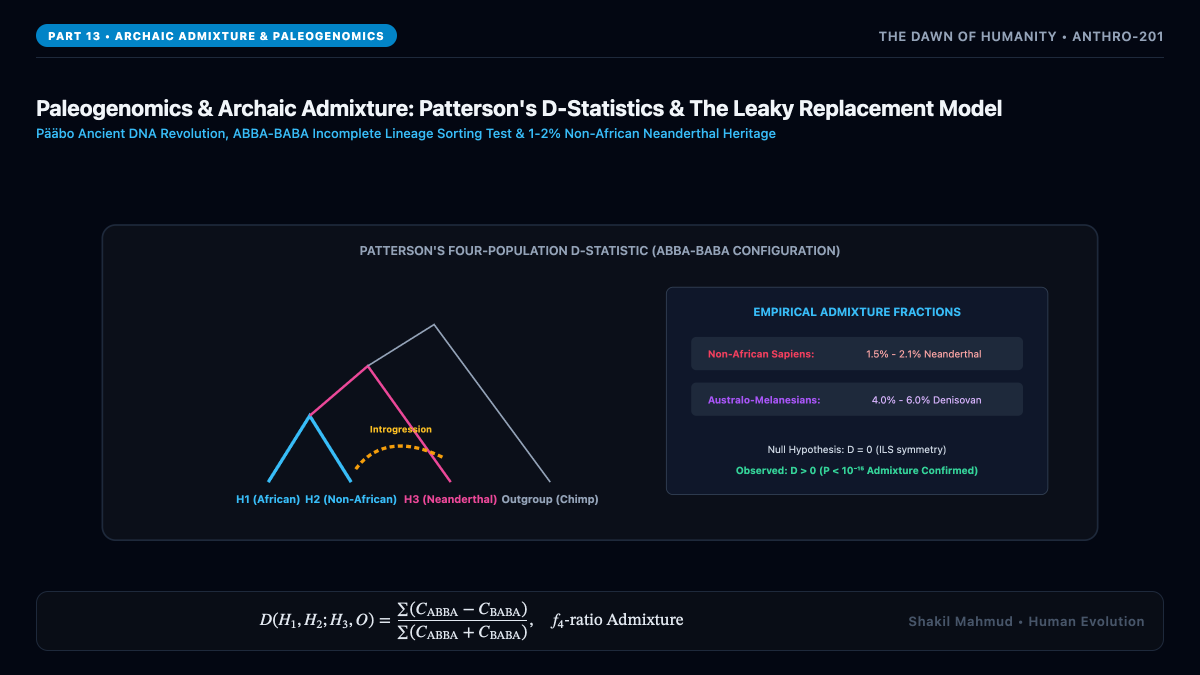
For nearly a century, the emergence of modern humans was framed as a bitter theological and scientific schism between two irreconcilable paradigms: the “Recent African Origin” (Complete Replacement) model, which posited that Homo sapiens swept out of Africa and completely wiped out archaic hominins without interbreeding; and the “Multiregional Evolution” model, which claimed modern races evolved in parallel from local archaic ancestors across the Old World. In 2010, the ancient DNA revolution led by Svante Pääbo shattered both paradigms, revealing the true history of our species: The Leaky Replacement Model.
1. The Technical Triumph of Ancient DNA (aDNA)
Sequencing DNA from fossils tens of thousands of years old was long deemed impossible by molecular biologists. Post-mortem cellular autolysis and geological time expose nucleic acids to severe degradation:
- Fragmentation: Endogenous aDNA is typically shattered into ultrashort fragments ($30text{–}60text{ base pairs}$).
- Cytosine Deamination: Spontaneous hydrolytic loss of an amine group converts unmethylated cytosine ($C$) into uracil ($U$). During PCR amplification, DNA polymerases read uracil as thymine ($T$), generating characteristic $C to T$ transition misincorporations at the $5’$-ends of ancient fragments.
- Massive Microbial Contamination: Up to $99.9%$ of DNA extracted from a fossil bone belongs to soil bacteria and fungi, alongside lethal contamination from modern human handlers.
Svante Pääbo and his team at the Max Planck Institute overcame these obstacles through ultra-clean room facilities, enzymatic uracil-DNA-glycosylase (UDG) repair, high-throughput next-generation sequencing (Illumina), and target-enrichment hybridization capture—culminating in the 2010 Neanderthal draft genome and earning Pääbo the 2022 Nobel Prize in Physiology or Medicine.
2. The Mathematical Engine of Admixture: Patterson’s $D$-Statistic (ABBA-BABA)
To rigorously prove whether modern humans interbred with archaic Neanderthals without confounding from ancestral population substructure, Nick Patterson and David Reich formulated Patterson’s $D$-statistic, widely known as the ABBA-BABA test.
Consider a four-taxon phylogenetic tree with the unrooted topology:
$$(((H_1, H_2), H_3), O)$$
Where $H_1$ is an African modern human, $H_2$ is a non-African modern human, $H_3$ is a Neanderthal, and $O$ is an ancestral ape outgroup (chimpanzee). At any biallelic locus where the derived allele ($B$) is distinct from the ancestral allele ($A$ defined by the outgroup), there are two phylogenetically discordant site patterns:
- ABBA Pattern: $H_1$ carries $A$, while $H_2$ and $H_3$ share the derived allele $B$.
- BABA Pattern: $H_1$ and $H_3$ share derived allele $B$, while $H_2$ carries ancestral allele $A$.
Under a null hypothesis of strict tree-like evolution with no gene flow, discordant patterns can arise only through Incomplete Lineage Sorting (ILS) in the ancestral population. Because genetic drift is neutral, the probability of ILS producing an ABBA pattern is mathematically identical to producing a BABA pattern ($E[C_{text{ABBA}}] = E[C_{text{BABA}}]$).
Patterson’s $D$-statistic calculates the normalized asymmetry between these two configurations across millions of autosomal SNPs:
$$D(H_1, H_2; H_3, O) = frac{sum_{i=1}^n left( C_{text{ABBA}}(i) – C_{text{BABA}}(i) right)}{sum_{i=1}^n left( C_{text{ABBA}}(i) + C_{text{BABA}}(i) right)}$$
When evaluated across global populations:
- If $D = 0$: The null hypothesis of zero gene flow is accepted.
- If $D > 0$: There is a statistically significant excess of shared derived alleles between $H_2$ (non-Africans) and $H_3$ (Neanderthals), decisively rejecting incomplete lineage sorting in favor of archaic admixture.
Empirical calculations across whole-genome sequences yield $D gg 0$ with $Ztext{-scores} > 5.0$ ($P < 10^{-15}$). All non-African populations (Europeans, Asians, Indigenous Americans, and Oceanians) carry between $1.5%$ and $2.1%$ Neanderthal ancestry.
3. Quantifying Admixture: The $f_4$-Ratio Estimator
To calculate the precise proportion of archaic ancestry ($alpha$) in a target population, population geneticists employ the $f_4$-ratio estimator:
$$hat{alpha} = frac{f_4(A, O; X, C)}{f_4(A, O; B, C)} = frac{E[(p_A – p_O)(p_X – p_C)]}{E[(p_A – p_O)(p_B – p_C)]}$$
Where $X$ is the target modern population, $B$ is the archaic introgressing source (Neanderthal), $C$ is an unadmixed sister archaic lineage, and $A$ is an unadmixed modern outgroup. This estimator is mathematically robust against post-divergence genetic drift in the target lineage.
4. The Leaky Replacement Reality
Ancient DNA from Upper Paleolithic modern humans—such as Oase 1 from Romania ($40text{ ka}$), who had a Neanderthal ancestor merely four to six generations back ($6text{–}9%$ Neanderthal genome in enormous chromosome blocks)—proves that interbreeding was not an isolated freak event. It occurred recurrently in the Near East and across Eurasia between $60,000$ and $45,000$ years ago. Modern humans are an evolutionary palimpsest: an African lineage enriched by archaic alleles that helped our ancestors conquer new global pathogens, cold climates, and high altitudes.