Between $800,000$ and $300,000$ years ago, the Pleistocene climate plunged into high-amplitude, $100,000text{-year}$ glacial-interglacial cycles driven by Milankovitch orbital eccentricity. In this turbulent Middle Pleistocene epoch—long christened the “muddle in the middle” by paleoanthropologists—descendants of Homo erectus underwent a dramatic second pulse of encephalization, giving rise to large-brained archaic hominins (Homo heidelbergensis / Homo rhodesiensis) who laid the evolutionary, anatomical, and technological foundations for both Neanderthals and Homo sapiens.
1. The Taxon: Homo heidelbergensis vs Homo rhodesiensis
In 1907, an archaic hominin mandible was discovered in a sandpit at Mauer near Heidelberg, Germany. Designated Mauer 1 ($609text{ ka}$), it exhibited massive, chinless architecture paired with relatively small, human-like dentition. Across Europe and Africa, hominins with cranial capacities bridging $1,100text{ to }1,400text{ cm}^3$ were uncovered:
- Kabwe 1 (“Broken Hill”, Zambia, $299text{ ka}$): Often designated the holotype of Homo rhodesiensis, featuring a massive, continuous supraorbital torus (brow ridge) and an endocranial volume of $1,280text{ cm}^3$.
- Petralona (Greece), Bodo (Ethiopia, $600text{ ka}$), and Arago (France): Highlighting a pan-Old World dispersal of large-bodied, thick-skulled big-game hunters.
2. Sima de los Huesos: The Atapuerca Treasure Trove ($430text{ ka}$)
The deepest evolutionary secrets of the Middle Pleistocene were unlocked in the Sierra de Atapuerca in northern Spain. Deep within the Cueva Mayor system, at the bottom of a $13text{-meter}$ vertical chimney known as Sima de los Huesos (“Pit of Bones”), Juan Luis Arsuaga and his team recovered over $6,500$ fossil elements belonging to at least $28$ individual hominins, radiometrically dated to $430text{ ka}$.
Morphological craniometrics and ancient mitochondrial and nuclear DNA sequencing (Meyer et al., 2014, 2016) resolved a decades-old debate:
- Incipient Neanderthal Apomorphies: Sima crania (such as Cranium 17) exhibit incipient midfacial prognathism, a double-arched supraorbital torus, retromolar spaces, and taurodont molars, demonstrating that they are phylogenetically anchored to the European Neanderthal branch.
- Paleogenomic Anchor: High-coverage nuclear DNA extracted from Sima fossils proved that the divergence between the Neanderthal-Denisovan clade and the Homo sapiens lineage had already occurred before $430text{ ka}$, pushing the common ancestral split back to $550text{–}765text{ ka}$.
3. Mode 3 Levallois Prepared-Core Technology
The Middle Pleistocene witnessed a revolutionary cognitive leap in stone tool manufacturing: the invention of the Mode 3 Levallois technique (first recognized in the Parisian suburb of Levallois-Perret):
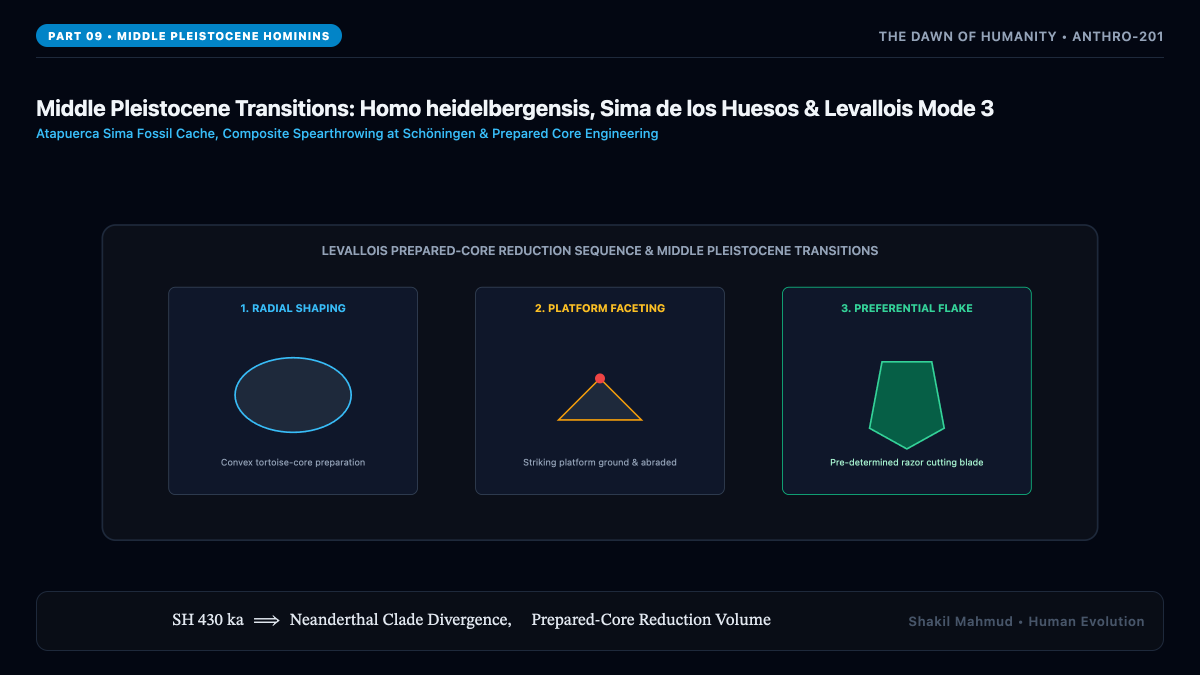
In Mode 2 Acheulean knapping, a handaxe was shaped by directly modifying a core. In Mode 3 Levallois, the core was merely an expendable vehicle prepared specifically to produce a predetermined, standardized flake. The knapping process followed three algorithmic stages:
- Centripetal Core Preparation: Flakes were systematically detached radially around the margins of a cryptocrystalline nodule, creating two intersecting convex surfaces (the “tortoise-core”).
- Striking Platform Faceting: A localized platform at one margin was abraded and faceted at a precise angle to receive the final percussive blow.
- Preferential Flake Detachment: A single, high-momentum blow directed parallel to the plane of intersection detached a predetermined, thin, razor-sharp flake with acute cutting margins spanning its entire circumference.
4. Big-Game Hunting & Composite Weaponry: Schöningen ($300text{ ka}$)
For decades, paleoanthropologists debated whether archaic Middle Pleistocene hominins were active big-game hunters or merely passive scavengers. In the 1990s, Hartmut Thieme excavated an opencast coal mine at Schöningen, Germany, uncovering ten complete spruce and pine wooden spears dated to $300text{ ka}$.
The Schöningen spears were not crude pointed sticks; they were aerodynamically shaped javelins up to $2.3text{ meters}$ in length, with their center of gravity located in the forward third of the shaft—identical to modern Olympic javelins. Found alongside the butchered skeletons of dozens of wild horses (Equus mosbachensis), they proved that Homo heidelbergensis operated as cooperative, organized, lethal ambush predators capable of felling Pleistocene megafauna.