Between $70,000$ and $15,000$ years ago, a single species of bipedal African primate broke through every geographical, ecological, and climatic barrier on planet Earth. Armed with sophisticated symbolic culture, composite projectile technology, tailoring, and seafaring watercraft, Homo sapiens swept across Eurasia, crossed treacherous open oceans to reach Australia, and traversed glaciated sub-Arctic landscapes to colonize the Americas. Wherever our ancestors arrived, ecosystems were permanently remade, and the massive beasts that had dominated the Pleistocene fell silent.
1. The Southern Coastal Route & The Peopling of Sahul ($65text{–}50text{ ka}$)
While an early, transient dispersal of modern humans reached the Levant by $sim 120text{ ka}$ (Skhul and Qafzeh), the definitive, successful wave of modern human global expansion exited Africa between $65,000text{ and }50,000text{ years ago}$. Mitochondrial haplogroup L3 gave rise to the basal Eurasian macro-haplogroups M and N, while Y-chromosome haplogroup CT spawned clades C and F.
Populations tracked a rapid Southern Dispersal Route along the coastlines of the Indian Ocean, exploiting rich intertidal marine resources. By $65text{ ka}$ (Madjedbebe, Arnhem Land) or at least $50text{ ka}$, modern humans arrived in Sahul (the Pleistocene continent uniting Australia, New Guinea, and Tasmania):
Reaching Sahul required crossing Wallacea, which even at glacial lowstands required traversing at least eight distinct sea crossings, including a final open-ocean leg of $> 70text{ kilometers}$ out of sight of land. This proves that 50,000 years ago, modern humans possessed intentional maritime navigation, constructed seaworthy rafts or canoes, and coordinated deliberate oceanic colonization.
2. The Colonization of the Americas: Beringia and White Sands
For decades, American archaeology was dominated by the “Clovis First” paradigm, which held that humans crossed the Beringian land bridge from Siberia around $13,000text{ years ago}$ through an ice-free corridor between the Laurentide and Cordilleran ice sheets. That dogma has been shattered by older discoveries:
- Monte Verde (Chile, $14.5text{–}18.5text{ ka}$): Well-preserved wood, stone tools, and cooked plant remains proving humans had reached the southern tip of South America long before the Clovis horizon.
- White Sands National Park (New Mexico, $23text{–}21text{ ka}$): Radiocarbon dating of aquatic plant seeds (Ruppia occidentalis) embedded directly within fossilized human footprints walking alongside giant ground sloths and mammoths, proving human presence in North America at the Last Glacial Maximum (LGM).
Genomic and archaeological consensus now favors the Pacific Coastal Migration Highway (Kelp Highway), where maritime foragers skirted the glaciated Alaskan coastline in skin boats before dispersing rapidly southward.
3. The Quaternary Megafaunal Collapse: The Overkill Hypothesis
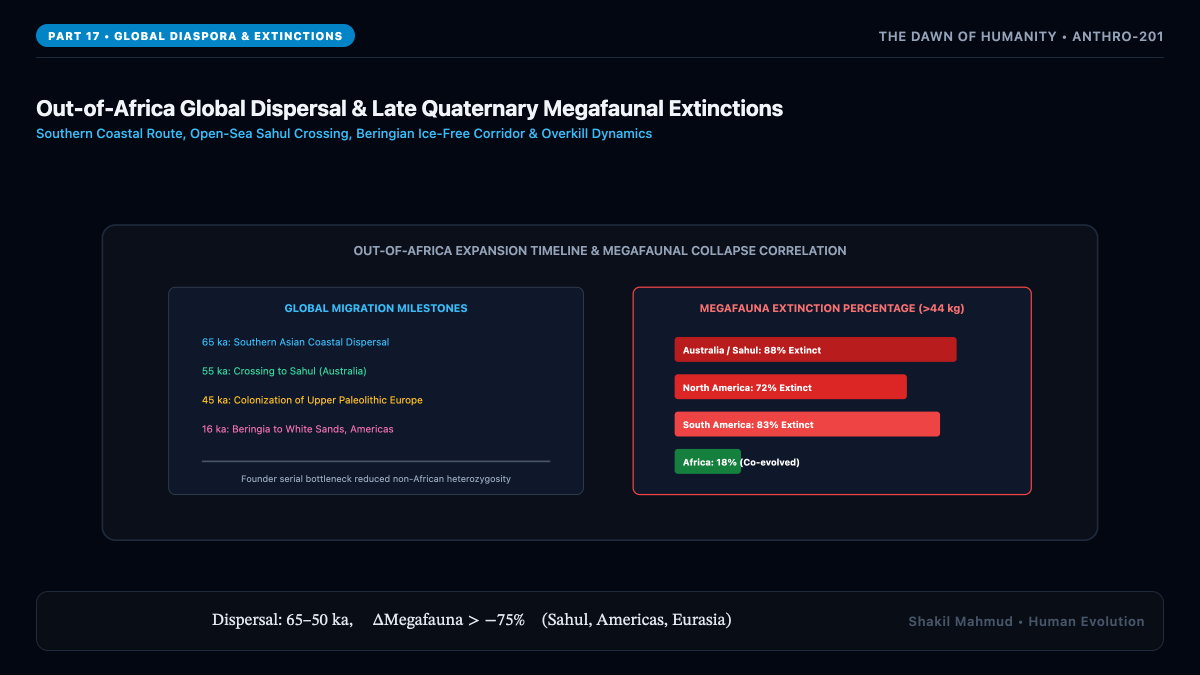
Wherever modern humans set foot on virgin continents, the native megafauna—animals with an adult body mass exceeding $44text{ kg}$ ($100text{ lbs}$)—suffered sudden, catastrophic collapse. Formulated by Paul S. Martin as the Overkill Hypothesis, this phenomenon tracks human arrival with chilling precision:
$$text{Megafauna Extinction Fraction: } quad Delta_{text{megafauna}} = frac{N_{text{extinct}}}{N_{text{total}}}$$
| Continent / Region | Human Arrival Time | Megafaunal Extinction Rate | Lost Pleistocene Genera |
|---|---|---|---|
| Australia (Sahul) | $sim 55,000text{ BP}$ | $88%$ ($14$ of $16$ genera) | Diprotodon (giant wombat), Genyornis (thunder bird), Thylacoleo (marsupial lion) |
| North America | $sim 16,000text{ BP}$ | $72%$ ($34$ of $47$ genera) | Mammuthus (mammoths), Mammut (mastodons), Smilodon, Equus |
| South America | $sim 15,000text{ BP}$ | $83%$ ($50$ of $60$ genera) | Megatherium (giant sloth), Glyptodon (armored armadillo), Toxodon |
| Sub-Saharan Africa | Co-evolution ($300text{ ka}$) | $18%$ (Minimal collapse) | African fauna co-evolved alongside hominins, developing innate fear of human predators |
Unlike African megafauna, which had co-evolved with hominin hunting strategies for three million years and developed an innate flight response, naive island and continental megafauna had never encountered a pack-hunting, spear-throwing, fire-wielding biped. Their low reproductive rates ($rtext{-selection}$) could not absorb even modest anthropogenic predation, triggering the first pulse of the ongoing Sixth Mass Extinction.