Around $1.9text{ million years ago}$, in the Pleistocene savannahs of eastern Africa, a hominin appeared that fundamentally resembled modern humans from the neck down. Tall, slender, long-legged, and free from the arboreal confines of its ancestors, Homo erectus (often termed Homo ergaster in its early African context) revolutionized our lineage. Armed with bilateral Acheulean stone axes and a physiological capacity for long-distance persistence hunting, this species shattered the geographical boundaries of Africa to inaugurate the first intercontinental hominin diaspora.
1. Turkana Boy (KNM-WT 15000): The Miracle of Postcranial Modernity
In August 1984, Kamoya Kimeu of Richard Leakey’s team spotted a tiny fragment of cranial vault on the banks of the Nariokotome River near Lake Turkana, Kenya. The resulting excavation yielded KNM-WT 15000 (“Turkana Boy”), a $1.53text{-million-year-old}$ skeleton that remains the most complete early hominin ever recovered ($108$ bones preserved).
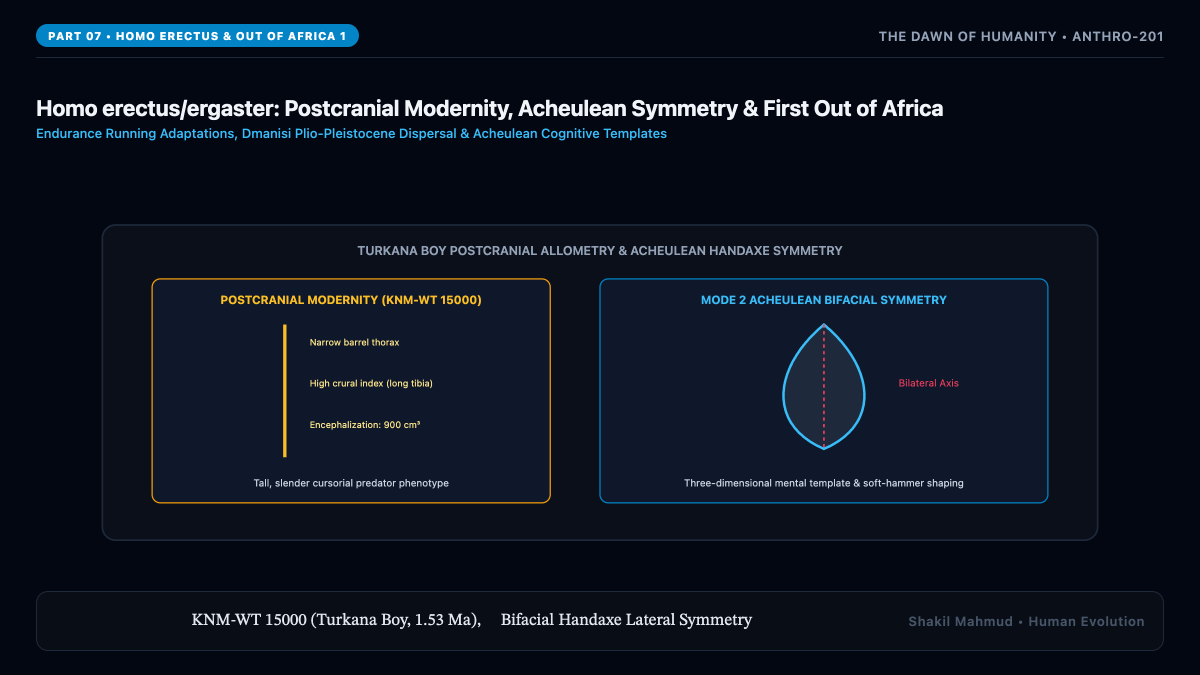
Histological analysis of dental perikymata reveals that Turkana Boy died as an $8text{-year-old}$ adolescent undergoing rapid somatic growth. His skeletal allometry presents an extraordinary departure from all earlier hominins:
- Stature & Adult Projection: Standing $160text{ cm}$ ($5text{ ft }3text{ in}$) at death, his projected adult height exceeded $185text{ cm}$ ($6text{ ft }1text{ in}$), with an estimated mass of $sim 68text{ kg}$.
- Body Proportions: He possessed a narrow, barrel-shaped thoracic cavity (lacking the conical funnel-shaped ribcage of apes and australopiths) and long, slender limbs. His crural index (tibia-to-femur length ratio) was high, matching modern equatorial populations adapted for radiant heat dissipation.
- Encephalization: Cranial capacity measured $880text{ cm}^3$ at death, projected to $approx 909text{ cm}^3$ in adulthood—double that of an australopithecine.
2. The Biomechanics of Endurance Running
Dennis Bramble and Daniel Lieberman (2004) formulated the landmark hypothesis that Homo erectus evolved not merely as a habitual walker, but as a specialized endurance runner. While quadrupedal ungulates are faster sprinters, they cannot gallop for extended periods under intense tropical heat without lethal hyperthermia because their respiration is mechanically locked 1:1 to stride frequency. Humans, by contrast, possess unique physiological and biomechanical adaptations for sustained cursorial locomotion:
- Thermoregulatory Sweating: Millions of eccrine sweat glands paired with complete loss of insulating body hair enabled convective evaporative cooling of up to $1text{ liter/hour}$, allowing hominins to run during midday heat when apex carnivores slept.
- Nuchal Ligament: An elastic fascial cord connecting the back of the skull to the spinous processes of the thoracic vertebrae, stabilizing the head against violent pitching during running (absent in chimps and australopiths).
- Gluteus Maximus Expansion: The gluteus maximus is virtually unused during normal flat walking; it contracts vigorously only during running and incline ascent, preventing the forward collapse of the torso at foot strike.
- Spring-Like Achilles Tendon: Long, compliant Achilles tendon and plantar vault storing elastic strain energy during deceleration and returning it at push-off.
3. Mode 2 Acheulean Technology: The First Cognitive Masterpieces
Around $1.76text{ Ma}$ at Kokiselei, Kenya, Homo erectus invented the Mode 2 Acheulean lithic industry. Unlike the opportunistic Oldowan flakes, the definitive Acheulean tool—the bifacial teardrop handaxe—required an extraordinary cognitive leap:
- Three-Dimensional Mental Template: The knapper must conceptualize a symmetrical, bilateral form hidden inside an amorphous boulder before striking the first blow.
- Soft-Hammer Technique: Following initial roughing out with a stone hammer, knappers used bone or antler percussors to detach thin, shallow thinning flakes across both faces, producing an undulating, razor-sharp lateral cutting margin.
4. Out of Africa 1: Dmanisi and the Eurasian Colonization
Equipped with this robust postcranium and technological repertoire, Homo erectus did not remain in Africa. By $1.8text{ Ma}$, hominins arrived at Dmanisi in the Republic of Georgia, leaving behind five pristine crania (endocranial volumes $546text{–}730text{ cm}^3$) alongside Oldowan-like choppers. From Dmanisi, populations moved rapidly across southern Asia, reaching the Sangiran and Trinil formations of Java ($1.6text{–}1.5text{ Ma}$) and the Nihewan Basin in northern China ($1.6text{ Ma}$). Homo erectus proved that the human body plan was an evolutionary passport capable of dominating every climatic zone from the tropics to cold temperate steppes.