In the entire history of paleoanthropology, almost every hominin species was discovered through skulls, jaws, or articulated skeletons. The Denisovans stand as the singular exception: a major continental branch of archaic humanity discovered entirely through paleogenomics. From a microscopic fragment of a child’s finger bone excavated in a remote Siberian cave emerged the genomic blueprint of an archaic lineage whose biological legacy survives today in the high Himalayas and the tropical islands of the Pacific.
1. Discovery in the Altai: Denisova Cave ($2008$)
In 2008, Russian archaeologists led by Anatoly Derevianko excavating Denisova Cave in the Altai Mountains of southern Siberia discovered a tiny fossil fragment: the distal phalanx of a juvenile female’s pinky finger (specimen Denisova 3), recovered from archaeological Layer 11, dated to $50,000text{–}75,000text{ years ago}$.
When the specimen was sent to Svante Pääbo’s laboratory at the Max Planck Institute for Evolutionary Anthropology in Leipzig, Germany, geneticist Johannes Krause sequenced its mitochondrial DNA (mtDNA). The results, published in 2010, shocked the world:
- Mitochondrial Divergence: While modern humans and Neanderthals differ by an average of $sim 202$ nucleotide positions across the mitochondrial genome, Denisova 3 differed from modern humans by an average of $sim 385$ positions. Its mitochondrial lineage had diverged from our common ancestor $approx 1.0text{ Ma}$—twice as deep as the human-Neanderthal split.
- High-Coverage Nuclear Genome: Subsequent nuclear DNA sequencing by Matthias Meyer (2012) achieved an unprecedented $30times$ coverage depth. The nuclear genome revealed that Denisovans were in fact the eastern sister group to the Neanderthals, having diverged from them $sim 400text{ ka}$ after their common ancestor separated from the lineage leading to Homo sapiens.
2. The Elusive Morphology: Teeth, Jaws, and the Harbin “Dragon Man”
While complete Denisovan skeletons remain elusive, subsequent discoveries have fleshed out their physical presence across eastern Asia:
- Denisova 4 & 8: Enormous, robust upper molars from Denisova Cave lacking the derived traits of Neanderthals and modern humans, possessing massive, sprawling roots reminiscent of Homo erectus.
- Xiahe Mandible ($160text{ ka}$): Found by a Buddhist monk in Baishiya Karst Cave on the Tibetan Plateau (Gansu, China). In 2019, palaeoproteomic analysis of ancient collagen proteins extracted from the dentin confirmed it was Denisovan, proving they inhabited high-altitude, hypoxic environments ($3,280text{ meters}$ above sea level) over $160,000$ years ago.
- The Harbin Cranium (“Dragon Man”, $146text{ ka}$): A massive, incredibly preserved cranium from northeast China possessing an endocranial volume of $1,420text{ cm}^3$, increasingly recognized as the morphological face of the Denisovans.
3. Adaptive Introgression: The EPAS1 High-Altitude Lifeline
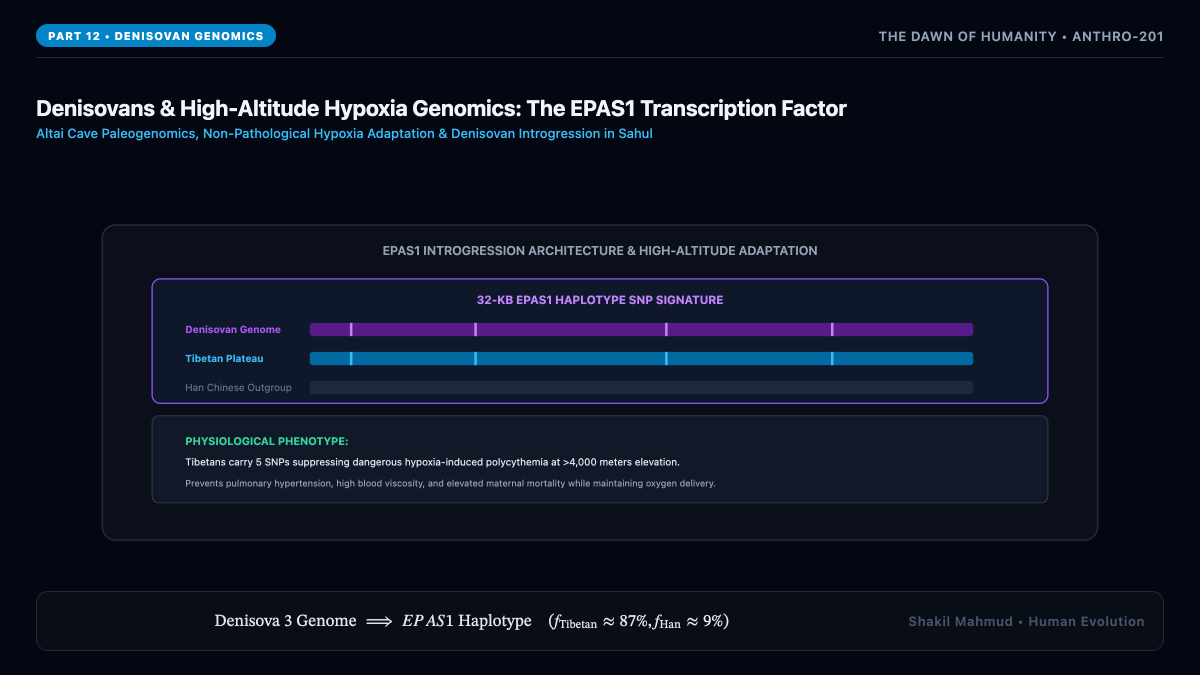
The most profound legacy of the Denisovans is etched directly into the living genome of modern humans. In 2010, whole-genome sequencing of native high-altitude Tibetan populations identified a staggering genomic signature of recent positive natural selection centered on the EPAS1 (Endothelial PAS Domain Protein 1) gene.
Under severe hypoxia ($> 4,000text{ meters}$ elevation), low atmospheric oxygen tension triggers the hypoxia-inducible factor (HIF) transcription pathway, causing normal lowland humans to overproduce red blood cells (erythrocytosis). This leads to dangerous blood hyperviscosity, chronic mountain sickness, and high maternal and fetal mortality. Tibetans, by contrast, maintain near-normal hemoglobin levels while thriving at extreme altitudes.
In 2014, Emilia Huerta-Sánchez and Rasmus Nielsen made an astonishing discovery:
$$text{Frequency of 5-SNP } EPAS1 text{ Haplotype: } f_{text{Tibetan}} approx 87%, quad f_{text{Han}} approx 9%$$
When the Tibetan $32text{-kb}$ haplotype block was aligned against global genomic databases, it matched no other modern human population on Earth. It was an exact, identical sequence match to the high-coverage Denisova genome. Ancestors of modern East Asians interbred with Denisovans, acquiring this beneficial transcription factor variant, which then underwent an explosive selective sweep ($s approx 0.03text{–}0.06$) as populations colonized the Tibetan Plateau.
4. Denisovan Heritage Across the Pacific
Denisovan admixture was not confined to Siberia. While modern mainland Eurasians carry minimal Denisovan ancestry ($< 0.1%$, except for the introgressed *EPAS1* locus), populations in Sahul (Indigenous Australians and Papuans) carry between $4%$ and $6%$ Denisovan ancestry throughout their genomes. This massive genetic footprint proves that Denisovans were geographically widespread across Southeast Asia, Wallacea, and Sundaland, representing a thriving, adaptable eastern empire of archaic humanity.