Around $2.8text{ million years ago}$, in the scorching volcanic terrain of eastern Africa, an evolutionary event took place that forever severed our lineage from the ecological constraints governing all other terrestrial animals. A population of hominins began intentionally manufacturing razor-sharp stone flakes from river cobbles. This was not mere expedient tool manipulation, but the emergence of culturally transmitted, reductive lithic engineering—the archaeological birth of the genus Homo.
1. The Oldest Known Homo: The Ledi-Geraru Mandible ($2.8text{ Ma}$)
For decades, the origin of the genus Homo was shrouded in the “muddle in the middle” between the last known Au. afarensis ($3.0text{ Ma}$) and early Homo habilis ($2.4text{ Ma}$). In 2013, Chalachew Seyoum discovered specimen LD 350-1 at Ledi-Geraru in the Afar Region of Ethiopia, dated radiometrically to $2.80text{–}2.75text{ Ma}$.
The LD 350-1 partial left adult mandible captures the precise morphological transition from australopith to Homo:
- Derived Homo Traits: Symmetrical, slender molar crowns with parallel dental arcade margins, absence of the sloping australopithecine mandibular simian shelf, and reduced mesiodistal molar lengths.
- Primitive Retentions: Sloping mandibular symphysis with a receding chin region.
2. Homo habilis: The “Handy Man” of Olduvai Gorge (OH 7)
In 1964, Louis Leakey, Phillip Tobias, and John Napier announced the discovery of fossil remains from Bed I of Olduvai Gorge, designating them Homo habilis (“handy man”). The holotype specimen, OH 7 (Johnny’s Child, $1.84text{ Ma}$), consisted of juvenile parietal bones, a fragmented mandible, and hand bones.
The defining anatomical attributes of H. habilis include:
- Encephalization: Endocranial capacity expanded to $600text{–}700text{ cm}^3$ (OH 7 estimated at $sim 647text{ cm}^3$), crossing Keith’s classic “cerebral rubicon” ($600text{ cm}^3$) and exhibiting distinct lateral expansion of Broca’s area in the left frontal lobe.
- Dentition: Post-canine teeth are markedly narrower and more gracile than in australopithecines, accompanied by reduced alveolar prognathism.
3. Biomechanics of the Knapping Hand: The Human Precision Grip
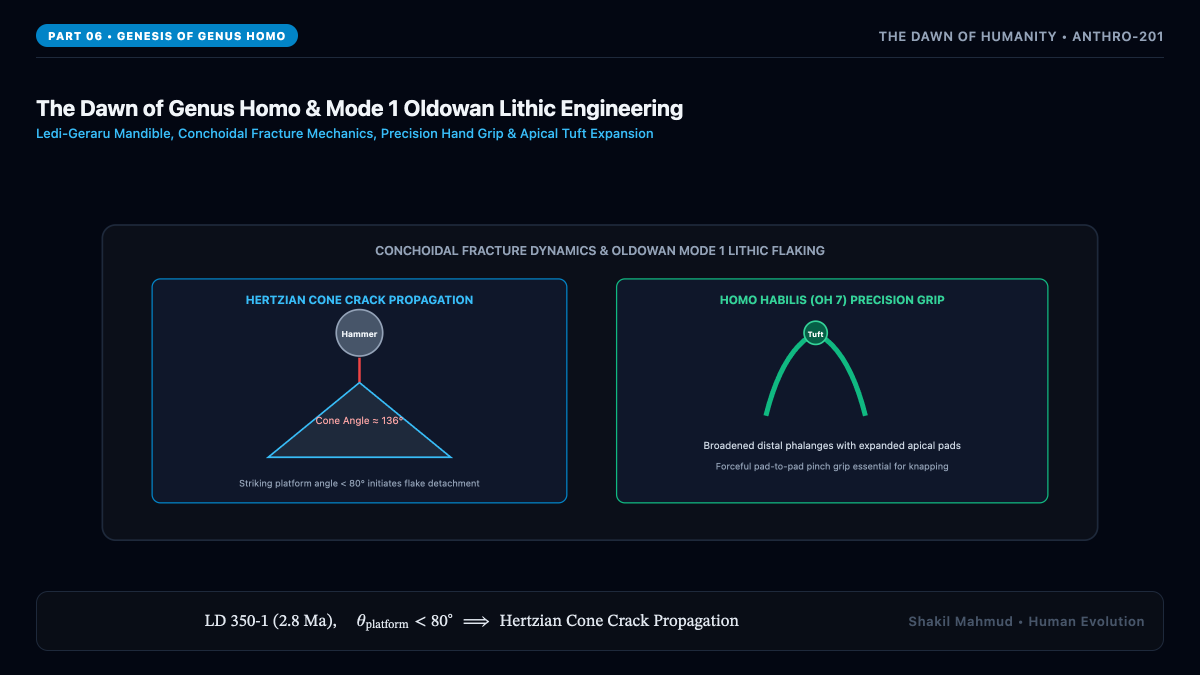
To manufacture stone tools, the primate hand had to be structurally remodeled. In non-human apes, long curved phalanges and a short thumb create a “power grip” suited for climbing and branch suspension, but incapable of stabilizing fine objects between the distal pads of the thumb and fingers. Homo habilis evolved the definitive precision grip:
- Elongated Pollex (Thumb): High thumb-to-finger length ratio ($> 60%$) allowing forceful opposition against all four fingertips.
- Broad Apical Tufts (Ungual Phalanges): The distal phalanges expanded into wide, spade-like bony pads with pronounced muscular insertion ridges for the flexor pollicis longus.
- Saddle-Shaped First Carpometacarpal Joint: Providing three rotational degrees of freedom while withstanding high axial percussive loads without articular subluxation.
4. The Physics of Fracture Mechanics: Conchoidal Fracture & Mode 1 Oldowan
The oldest systematic stone tool culture is the Mode 1 Oldowan, formally defined from Olduvai Gorge, Gona ($2.6text{ Ma}$), and Lomekwi ($3.3text{ Ma}$ for pre-Oldowan variants). An Oldowan toolmaker had to understand the principles of conchoidal fracture in isotropic, cryptocrystalline minerals (flint, chert, quartz, basalt):
When a hammerstone strikes an isotropic core rock adjacent to an edge, stress waves radiate downward in the shape of a Hertzian cone. For a sharp flake to detach rather than shattering the rock into crushed debris, the knapper must deliver the blow within strict geometric boundary parameters:
$$text{Striking Platform Angle: } theta_{text{platform}} < 80^circ$$
If $theta_{text{platform}} ge 90^circ$, the percussive shockwave dissipates into the bulk material without detaching a flake. When struck correctly at an acute angle with sufficient momentum ($p = mv$), tensile stress along the outer boundary of the Hertzian cone exceeds the rock’s tensile strength, detaching a flake exhibiting diagnostic archaeological markers:
- Striking Platform: The planar impact surface where the hammerstone landed.
- Bulb of Percussion: A smooth, bulbous swelling formed by the expanding shockwave directly beneath the point of impact.
- Eraillure Scar & Compression Ripples: Concentric waves radiating outward along the ventral flake surface, freezing the shockwave in stone.
5. Dietary Consequences: The Scavenging Niche
What were Oldowan tools used for? High-magnification microwear analysis of flake edges and bone cut marks at FLK Zinj (Olduvai) reveal that early Homo was not hunting apex carnivores, but exploiting a high-nutrient scavenging niche. Oldowan sharp flakes allowed hominins to rapidly slice muscle meat from ungulate carcasses before carnivores arrived, while heavy choppers and hammerstones were used to crack open dense limb bones, accessing rich marrow reserves previously unavailable to any savannah primate.