For nearly four hundred thousand years, across the harsh periglacial tundras, limestone steppes, and boreal forests of Pleistocene Eurasia, an extraordinary branch of humanity reigned supreme. Homo neanderthalensis was not the brutish, stooped troglodyte of Victorian scientific caricature, but an exceptionally large-brained, hyper-robust, culturally sophisticated apex predator specifically engineered by natural selection to master the brutally unforgiving climates of glacial Europe.
1. Discovery and Cranial Vault Architecture
In August 1856, quarry workers blasting limestone in the Neander Valley (Neandertal) near Düsseldorf, Germany, uncovered a skullcap and limb bones in Feldhofer Cave. Designated Neanderthal 1, it became the first recognized fossil hominin in history. Subsequent discoveries at La Chapelle-aux-Saints, La Ferrassie, Shanidar (Iraq), and Kebara (Israel) established the definitive hypodigm.
The Neanderthal cranium presents a suite of diagnostic apomorphies contrasting sharply with modern humans:
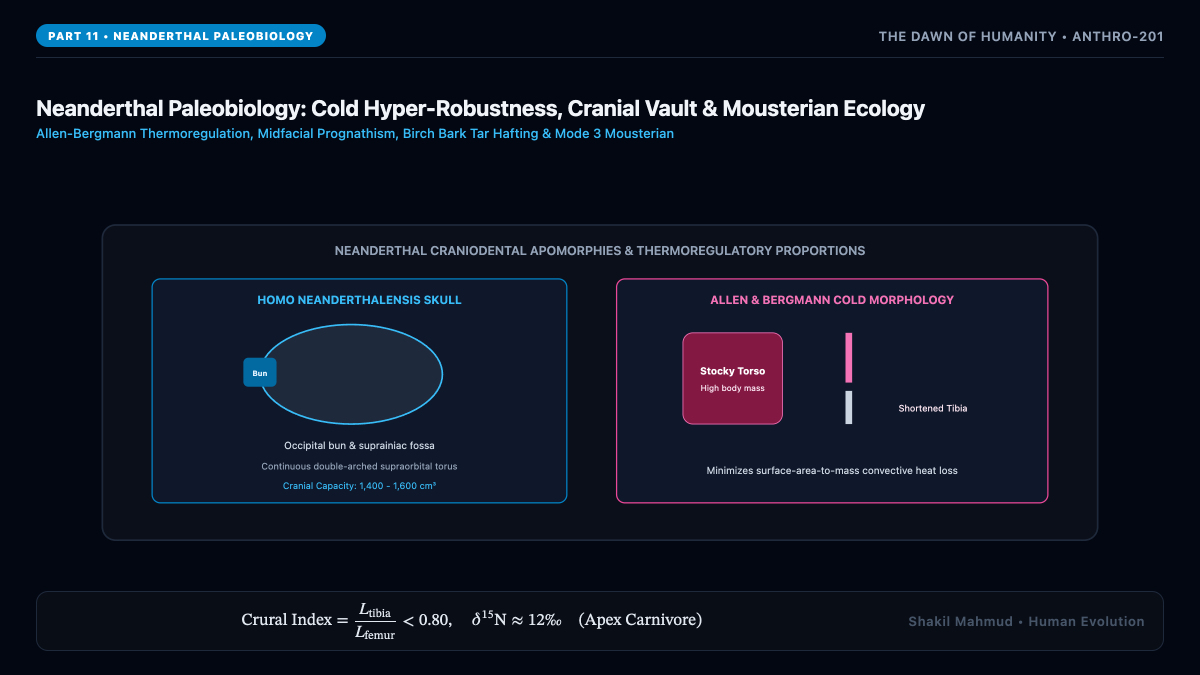
- Enormous Endocranial Volume: Adult cranial capacity averaged $1,400text{ to }1,600text{ cm}^3$ (often exceeding the modern human average of $1,350text{ cm}^3$), housed within a long, low, retro-projecting cranial vault (platycephaly).
- Occipital Bun (Chignon): A prominent, hemispherical posterior bulge of the occipital bone associated with a distinct suprainiac fossa.
- Supraorbital Torus & Midfacial Prognathism: A continuous, double-arched brow ridge framing large, rounded orbits, accompanied by anterior projection of the midface and nasal aperture, pulling the cheekbones backward.
- Dentition: Retromolar space (a gap behind the third molar created by midfacial projection) and taurodontism (enlarged pulp cavities and fused roots providing long-lasting dental endurance).
2. The Biomechanics of Cold Adaptation: Allen’s and Bergmann’s Rules
The postcranial skeleton of Neanderthals is a textbook embodiment of ecogeographical thermal adaptation governed by Bergmann’s Rule (body mass increases in colder climates to minimize surface-area-to-volume ratio) and Allen’s Rule (appendages shorten relative to trunk length to reduce radiant heat loss):
The distal segments of the extremities are significantly truncated, quantified by the Crural Index (tibia length relative to femur length):
$$text{Crural Index} = frac{L_{text{tibia}}}{L_{text{femur}}} times 100$$
| Population / Species | Crural Index (%) | Climatic Adaptation |
|---|---|---|
| Modern Equatorial African | $85% – 87%$ | Elongated distal limbs for radiant convective cooling |
| Modern Arctic Inuit | $77% – 79%$ | Truncated distal limbs for core heat retention |
| Classic Neanderthals | $76% – 79%$ | Hyper-cold adapted periglacial morphotype |
Neanderthals possessed extremely broad bi-iliac pelvic diameters, barrel-shaped ribcages, thick-walled cortical bones, and massive muscle insertion crests, reflecting a metabolic maintenance cost requiring an estimated $4,000text{ to }5,500text{ kcal/day}$ in deep winter.
3. Stable Nitrogen Isotopes: The Apex Carnivore Paradigm
Stable nitrogen isotope ratios ($delta^{15}text{N}$) in bone collagen fractionate upward by $+3text{ to }+5‰$ at each successive trophic step in the food chain. Analyzed across dozens of European specimens (Bocherens et al., 2005; Richards et al., 2008), Neanderthals systematically yield:
$$delta^{15}text{N} approx 10text{ to } 12‰$$
These values placed Neanderthals at the absolute apex of the European Pleistocene food web, matching or exceeding contemporaneous apex carnivores such as cave hyenas (Crocuta crocuta spelaea) and wolves. Their primary prey consisted of massive terrestrial herbivores: woolly mammoths (Mammuthus primigenius), woolly rhinos (Coelodonta antiquitatis), and steppe bison.
4. Mode 3 Mousterian Culture & Hafted Composite Technology
Neanderthals were the masters of the Mode 3 Mousterian lithic culture. They refined Levallois flake reduction to produce specialized sidescrapers (racloirs), denticulates, and triangular Mousterian points. Crucially, Neanderthals invented chemical adhesive manufacturing: they heated birch bark in oxygen-deprived conditions to synthesize birch bark pitch (tar), using it as a thermoplastic glue to lash stone points onto wooden spear shafts—the earliest chemically synthesized composite technology in human prehistory.
5. Symbolic Behavior and Mortuary Practices
Long denied symbolic cognition, recent archaeological excavations have revealed that Neanderthals possessed complex cultural repertoires: deliberate burial of the dead at Shanidar Cave, Iraq (the debated “flower burial”) and La Chapelle-aux-Saints; personal adornment with raptor talons and marine shells stained with red ochre at Cueva de los Aviones (Spain, $115text{ ka}$); and geometric non-figurative parietal markings in Spanish caves (La Pasiega, Maltravieso, and Ardales, dated by uranium-thorium to $> 64.8text{ ka}$)—predating the arrival of modern Homo sapiens in Europe.