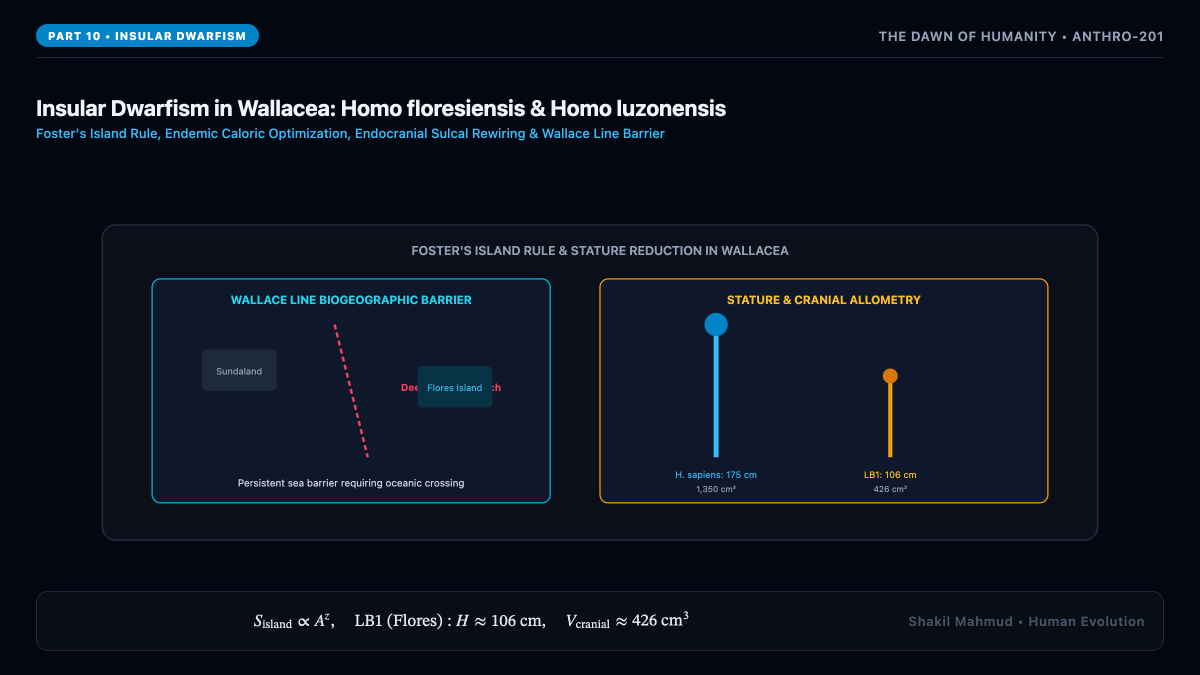
In the year 2003, in the limestone cave of Liang Bua on the remote Indonesian island of Flores, an archaeological team unearthing Pleistocene deposits made a discovery that stunned the global scientific community. Emerging from six meters of clay was a nearly complete adult hominin skeleton standing just $106text{ cm}$ tall, with a cranial capacity no larger than that of a chimpanzee. Dubbed the “Hobbit”, Homo floresiensis demonstrated that human evolution was not a linear march toward increasing brain size and stature, but a bush subjected to the powerful ecological laws of island biogeography.
1. The Discovery and Anatomy of LB1: The “Hobbit” of Liang Bua
Specimen LB1, discovered by a joint Australian-Indonesian team led by Mike Morwood and Raden Soejono, represents an adult female who lived approximately $60,000$ to $100,000$ years ago (with stone tools on the island extending to $1.0text{ Ma}$ at Mata Menge):
- Stature & Mass: LB1 stood precisely $106text{ cm}$ ($3text{ ft }6text{ in}$) tall, with an estimated adult body weight of $25text{ to }30text{ kg}$.
- Cranial Capacity: Measured at just $426text{ cm}^3$—smaller than Lucy and within the range of an average wild chimpanzee.
- Dental & Facial Morphology: Despite its tiny brain, LB1 exhibited small, gracile teeth, a flat facial profile with reduced prognathism, and an absence of the massive masticatory chewing apparatus seen in australopiths, allying it unequivocally with the genus Homo.
- Postcranial Primitive Retentions: Long feet with flat, archless soles, a short, ape-like clavicle with anteriorly rotated shoulders, and a flared pelvis reminiscent of australopithecines.
2. The Ecological Drivers: Foster’s Island Rule
How did a member of the genus Homo become so small? The answer lies in Foster’s Island Rule (insular dwarfism), a universal ecological law governing mammalian evolution on isolated oceanic islands:
When continental mammals colonize resource-constrained islands separated by deep oceanic trenches:
- Small mammals (rodents) experience insular gigantism due to the absence of continental mammalian predators.
- Large mammals (proboscideans, carnivores, ungulates) experience insular dwarfism because limited land area ($A$) restricts total primary biomass production ($K$). Natural selection aggressively favors smaller body mass ($M$) to reduce total caloric requirements and lower extinction risk during prolonged ecological droughts:
$$text{Metabolic Scaling: } BMR propto M^{0.75}$$
Flores sits east of the Wallace Line—a deep marine trench that remained submerged even during the lowest Pleistocene glacial sea-level lowstands (when Sundaland connected Sumatra, Java, and Borneo to the Asian mainland). Hominins likely arrived on Flores via accidental tsunamis or rafting $sim 1text{ Ma}$. Isolated with dwarfed pygmy elephants (Stegodon florensis insularis) and giant predatory Komodo dragons (Varanus komodoensis), ancestral Homo erectus underwent rapid evolutionary dwarfism.
3. The Endocranial Paradox: Small Brain, Complex Behavior
Critics initially dismissed LB1 as a modern human suffering from pathology—microcephalic dwarfism, Laron syndrome, or cretinism. However, virtual 3D endocranial reconstruction by Dean Falk (2005) disproved pathology:
LB1’s brain possessed an advanced, derived cortical layout. The frontal lobe exhibited pronounced lateral expansion of Brodmann area 10 (the frontopolar cortex, critical for working memory and multi-task planning) alongside expanded temporal and parietal association cortices. Despite having a brain volume of $426text{ cm}^3$, H. floresiensis successfully manufactured sophisticated stone tools, hunted juvenile stegodonts, and habitually controlled fire inside Liang Bua.
4. Homo luzonensis: The Philippine Counterpart ($67text{ ka}$)
In 2019, Florent Détroit and Armand Mijares announced an equally startling discovery from Callao Cave on the island of Luzon in the northern Philippines: Homo luzonensis, dated to $67text{ ka}$.
Consisting of tiny, curved foot phalanges, finger bones, and extremely small molars from at least three individuals, H. luzonensis confirmed that insular dwarfism and endemic speciation were widespread across Pleistocene Wallacea. These island species demonstrate that while large-brained Homo sapiens and Neanderthals were dominating continental landmasses, forgotten evolutionary experiments thrived on the remote oceanic fringes of Southeast Asia until modern humans arrived.