For half a century, the prevailing narrative of human origins was anchored in a comforting, localized creation myth: modern Homo sapiens, possessing modern anatomy and behavioral genius, arose suddenly around $200,000text{ years ago}$ in a single, idyllic “Garden of Eden” located in the Great Rift Valley of East Africa. In 2017, a landmark discovery in a barite mine on the edge of the Moroccan desert dismantled this paradigm, replacing it with a far richer, continental reality: The Pan-African Metapopulation Model.
1. Jebel Irhoud: The North African Revolution ($315text{ ka}$)
In the 1960s, miners at Jebel Irhoud, $100text{ km}$ west of Marrakesh, Morocco, accidentally broke into a cave containing an archaic skull (Irhoud 1). Initially assumed to be an African Neanderthal dated to $sim 40text{ ka}$, the site was re-excavated in 2004 by an international team led by Jean-Jacques Hublin of the Max Planck Institute.
Hublin’s team recovered cranial, mandibular, and dental remains of at least five individuals alongside Levallois stone tools and animal bones. Thermoluminescence (TL) dating of heated flints and electron spin resonance (ESR) dating of tooth enamel delivered a tectonic revelation:
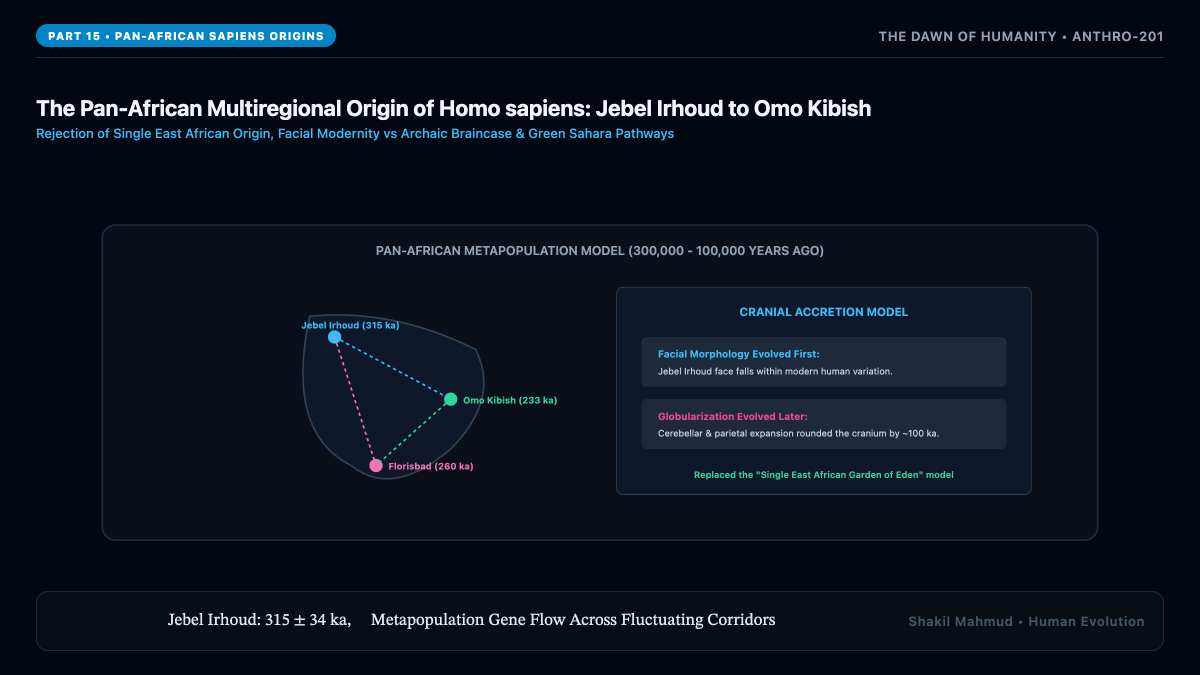
$$text{Age of Jebel Irhoud Hominins: } quad 315,000 pm 34,000text{ years ago}$$
Jebel Irhoud pushed back the origin of Homo sapiens by more than $100,000text{ years}$, proving that the roots of our species were established across the continent long before the Late Pleistocene.
2. The Cranial Accretion Model: Facial Modernity vs Neurocranial Globularization
High-resolution micro-CT reconstruction of the Jebel Irhoud skulls revealed a fundamental biological insight: the modern human cranial architecture did not emerge overnight as a single genetic package, but through mosaic, stepwise accretion:
- Facial Modernity Evolved First: The facial skeleton of Jebel Irhoud is completely modern. It possesses a delicate, retracted midface tucked beneath the anterior cranial fossa, delicate zygomatic arches, canine fossae, and gracile maxillary alveolar architecture that falls completely within the morphospace of living humans.
- The Archaic Neurocranium: By contrast, the braincase remains primitive: elongated, low, and retro-projecting (platycephalic), with an endocranial volume of $approx 1,375text{ cm}^3$ (fully modern in size, but archaic in shape).
Studies by Philipp Gunz and Simon Neubauer (2018) established that globularization—the evolutionary rounding of the parietal and cerebellar regions into a spherical, globular neurocranium—did not reach its modern state until between $130,000text{ and }100,000text{ years ago}$, driven by the expansion of parietal association cortices and cerebellar neural networks dedicated to spatial cognition and symbolic computation.
3. The Pan-African Metapopulation Network
Modern humans did not originate in Morocco alone, nor in Ethiopia alone. Across the vast African landmass, Middle Pleistocene fossils preserve regional puzzle pieces of our species:
- Jebel Irhoud (Morocco, $315text{ ka}$): Modern facial architecture with archaic braincase.
- Florisbad (South Africa, $260text{ ka}$): A partial cranium exhibiting transitional frontal morphology.
- Omo Kibish 1 (Ethiopia, $233text{ ka}$): Dated by Celine Vidal via volcanic tephra to $233text{ ka}$, presenting a high cranial vault, prominent chin (mental protuberance), and advanced postcranial modernity.
- Herto (Ethiopia, $160text{ ka}$): Homo sapiens idaltu, combining massive stature with near-complete cranial modernity.
Eleanor Scerri and colleagues (2018) synthesized these discoveries into the African Multiregionalism (Metapopulation) Model. Throughout the Pleistocene, Africa was divided by shifting environmental barriers (the Sahara Desert, tropical rainforests) into fragmented ecological zones. During humid “Green Sahara” and “Green Arabia” pluvial phases, monsoonal corridors opened, allowing geographically isolated populations to connect, exchange genes and stone tool cultures, and then fragment again during arid periods.
Modern humans are the product of this dynamic, continental gene-flow network: no single localized population represents the sole ancestor of humanity. We are the unified evolutionary harvest of the entire African continent.