If geometry is the study of space, algebra is the formal study of symmetry and structure. In pure mathematics, a Group is the minimal axiomatic system capable of capturing the reversible transformations of an object. From the symmetries of crystalline lattices and subatomic gauge fields to the unsolvability of polynomial equations, group theory provides the fundamental structural alphabet across abstract algebra.
1. The Four Group Axioms
A group $(G, cdot)$ is a set $G$ endowed with a binary operation $cdot: G times G to G$ satisfying four foundational axioms:
- Closure: $forall a, b in G, ; a cdot b in G$.
- Associativity: $forall a, b, c in G, ; (a cdot b) cdot c = a cdot (b cdot c)$.
- Identity Element: $exists e in G text{ such that } forall a in G, ; e cdot a = a cdot e = a$.
- Inverse Element: $forall a in G, ; exists a^{-1} in G text{ such that } a cdot a^{-1} = a^{-1} cdot a = e$.
If the group operation is additionally commutative ($a cdot b = b cdot a$), $G$ is termed an Abelian Group.
2. Subgroups, Cosets & Lagrange’s Theorem
A subset $H subseteq G$ is a Subgroup ($H le G$) if it forms a group under the restricted operation. For any element $g in G$, the left coset of $H$ is $gH = {gh mid h in H}$. The cosets of $H$ partition $G$ into mutually disjoint equivalence classes of equal cardinality $|H|$.
This simple geometric fact yields Lagrange’s Theorem, one of the most celebrated structural results for finite groups:
|G| = [G : H] cdot |H|
Where $[G : H]$ is the index (number of cosets). Lagrange’s theorem dictates that the order of any subgroup $H$, and the order of any element $g in G$, must divide the order of the parent group $|G|$. An immediate corollary is that every group of prime order $p$ is strictly cyclic and isomorphic to $mathbb{Z}_p$.
3. Normal Subgroups & The Quotient Group Construction
Can we turn the set of cosets $G/H$ into a group in its own right? Multiplying cosets via $(aH)(bH) = (ab)H$ is well-defined if and only if $H$ is invariant under all inner automorphisms—defining a Normal Subgroup ($N triangleleft G$):
forall g in G, ; g N g^{-1} = N quad Longleftrightarrow quad gN = Ng
When $N triangleleft G$, the coset space $G/N$ forms the Quotient Group (or factor group). Quotienting acts as an algebraic lens: it collapses the internal structure of $N$ to the identity element, isolating the global “macro-symmetry” of $G$.
4. Homomorphisms & The First Isomorphism Theorem
A map $phi: G to H$ between two groups is a Homomorphism if it preserves the algebraic operation: $phi(a cdot_G b) = phi(a) cdot_H phi(b)$. The structure of $phi$ is governed by two fundamental sub-objects:
- The Kernel: $ker(phi) = {g in G mid phi(g) = e_H}$. The kernel is always a normal subgroup of $G$ ($ker(phi) triangleleft G$).
- The Image: $text{im}(phi) = {phi(g) mid g in G} le H$.
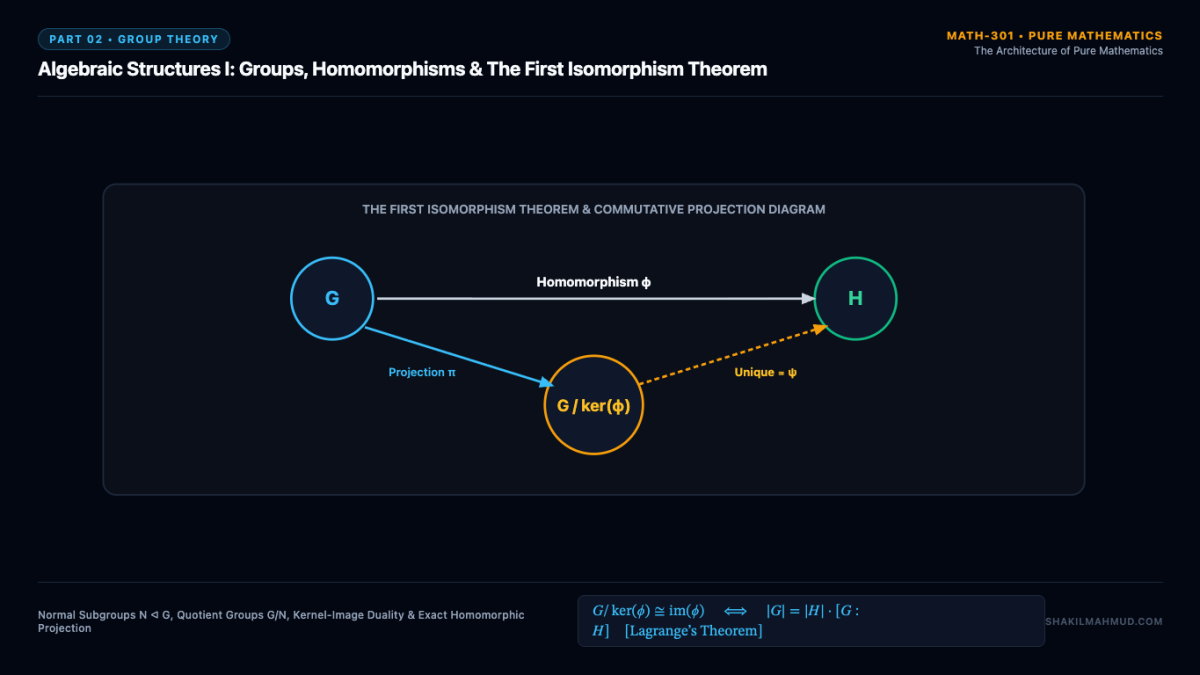
The relationship between kernels, quotients, and images is immortalized by the First Isomorphism Theorem:
G / ker(phi) cong text{im}(phi)
There exists a canonical, unique isomorphism $bar{phi}: G/ker(phi) to text{im}(phi)$ defined by $bar{phi}(g ker(phi)) = phi(g)$. Every homomorphic image of a group is algebraically identical to a quotient of the group by the kernel of the map—establishing the universal bridge between symmetry, projection, and abstraction.