Calculus relies upon the notion of limits and continuity, traditionally defined using the Euclidean metric distance $|x – y| < epsilon$. Yet metric distances are rigid and arbitrary: continuity depends purely on qualitative proximity, not quantitative numbers. In the early twentieth century, Felix Hausdorff, Kazimierz Kuratowski, and Maurice Fréchet stripped away all rulers to create General Point-Set Topology—the mathematical science of shape, connection, and proximity formulated purely through open sets.
1. The Axiomatic Definition of a Topological Space
A Topological Space $(X, tau)$ is a set $X$ equipped with a collection $tau subseteq mathcal{P}(X)$ of subsets called Open Sets, satisfying three foundational axioms:
- The empty set and the whole space belong to the topology: $emptyset in tau$ and $X in tau$.
- The arbitrary union of open sets is open: if ${U_i}_{i in I} subseteq tau$, then $bigcup_{i in I} U_i in tau$.
- The finite intersection of open sets is open: if $U_1, dots, U_n in tau$, then $bigcap_{k=1}^n U_k in tau$.
A subset $F subseteq X$ is Closed if its complement $X setminus F$ is open. A continuous function $f: X to Y$ is defined with breathtaking simplicity: the preimage of every open set in $Y$ is open in $X$ ($f^{-1}(V) in tau_X$ for all $V in tau_Y$). Metrics are completely discarded.
2. The Separation Axioms ($T_0$ through $T_4$)
Without metrics, points can become topologically indistinguishable. Topologists classify spaces through the hierarchy of Separation Axioms:
- $T_0$ (Kolmogorov): For any two distinct points, there exists an open set containing one but not the other.
- $T_1$ (Fréchet): For any two distinct points $x neq y$, each has an open neighborhood not containing the other (every singleton ${x}$ is closed).
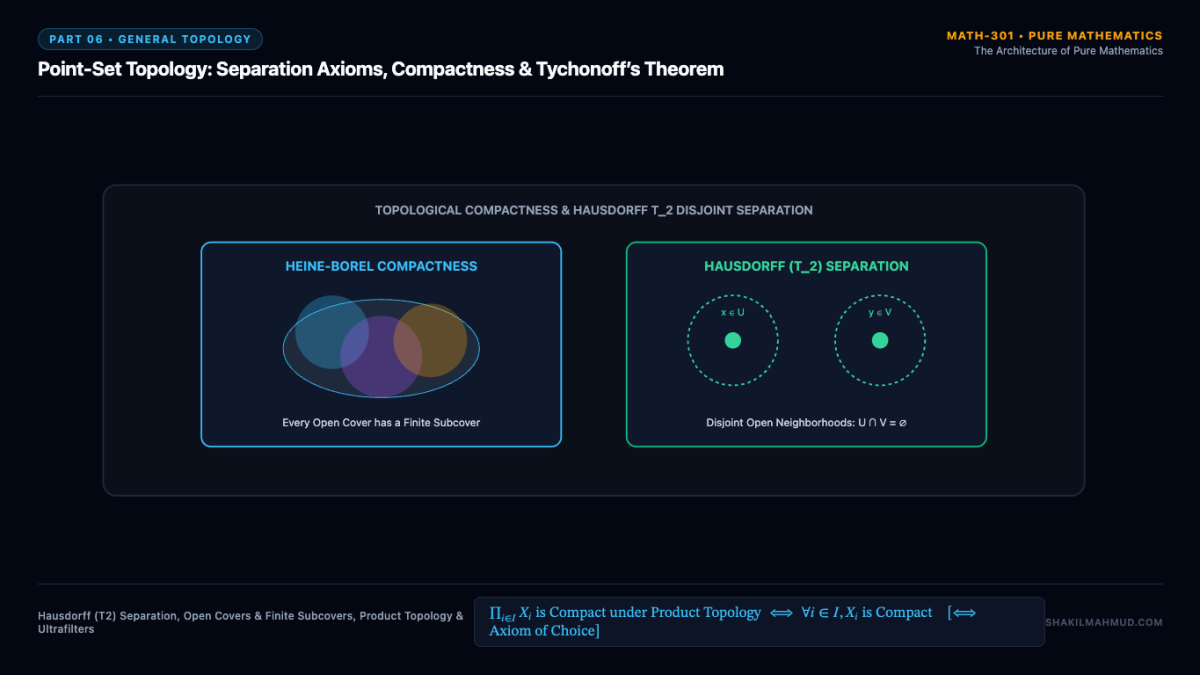
- $T_2$ (Hausdorff): For any two distinct points $x neq y$, there exist disjoint open neighborhoods $U, V$ such that $x in U$, $y in V$, and $U cap V = emptyset$. In Hausdorff spaces, convergent sequences have unique limits.
- $T_3$ (Regular Hausdorff): Any closed set and disjoint point can be separated by disjoint open sets.
- $T_4$ (Normal Hausdorff): Any two disjoint closed sets can be separated by disjoint open sets. Urysohn’s Lemma guarantees that normal spaces admit continuous real functions separating closed sets, proving that every regular second-countable space is metrizable.
3. Compactness: The Topological Generalization of Finiteness
In metric spaces, the Heine-Borel theorem states that subsets of $mathbb{R}^n$ are compact if and only if they are closed and bounded. In general topology, boundedness has no meaning. Compactness is elevated to an intrinsic property of open covers:
X text{ is Compact} iff text{Every open cover } {U_i}_{i in I} text{ has a finite subcover } {U_{i_1}, dots, U_{i_k}}
Compactness acts as a magical bridge between the local and the global: any local property that holds on small open sets automatically holds globally across the entire space. As immediate consequences:
- The continuous image of a compact space is compact (The Extreme Value Theorem).
- Every closed subset of a compact space is compact.
- In a Hausdorff space, every compact subset is automatically closed.
4. Tychonoff’s Theorem & The Product Topology
Given an arbitrary family of topological spaces ${X_i}_{i in I}$, the Cartesian product $X = prod_{i in I} X_i$ is endowed with the Product Topology: the coarsest topology making all projection maps $pi_i: X to X_i$ continuous. Its open base consists of cylinder sets $prod_i U_i$ where $U_i = X_i$ for all but finitely many indices.
In 1930, Andrey Tychonoff proved the master theorem of general topology:
prod_{i in I} X_i text{ is Compact under the Product Topology} iff forall i in I, ; X_i text{ is Compact}
Tychonoff’s theorem holds for arbitrary, uncountably infinite index sets $I$. Because it requires the Ultrafilter Lemma (a variant of the Axiom of Choice), Tychonoff’s theorem is logically equivalent to ZFC itself, providing the fundamental compactness engine behind functional analysis (Banach-Alaoglu theorem) and algebraic geometry.