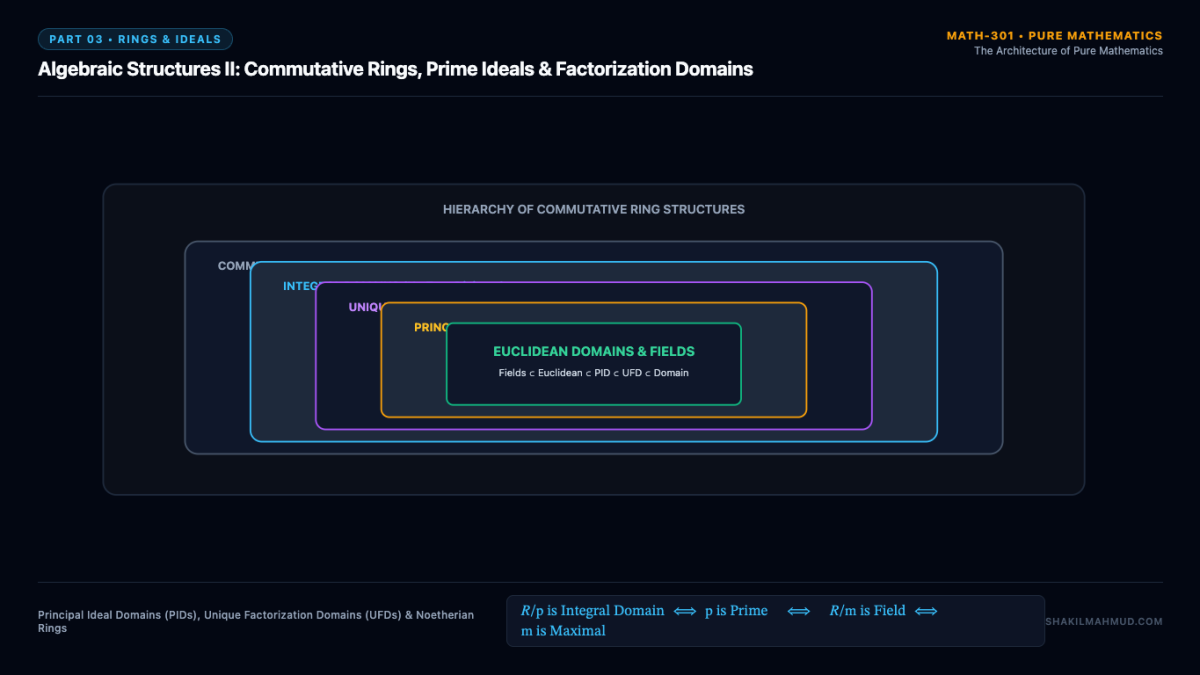
While a group formalizes a single operation (such as addition or composition), the fundamental systems of number theory and geometry—the integers $mathbb{Z}$, polynomial rings $k[x_1, dots, x_n]$, and continuous functions $C(X)$—possess two interacting operations: addition and multiplication. In abstract algebra, a Ring formalizes this dual arithmetic. The modern theory of rings, pioneered by Emmy Noether and Richard Dedekind, replaces individual numbers with geometric sub-objects called Ideals, laying the groundwork for algebraic geometry.
1. The Axiomatic Definition of a Ring
A ring $(R, +, cdot)$ is a set $R$ equipped with two binary operations such that:
- $(R, +)$ is an abelian group with additive identity $0$ and additive inverse $-a$.
- $(R, cdot)$ is a monoid: associative with multiplicative identity $1 neq 0$ ($a cdot (b cdot c) = (a cdot b) cdot c$ and $1 cdot a = a cdot 1 = a$).
- Multiplication distributes over addition: $a cdot (b + c) = a cdot b + a cdot c$ and $(a + b) cdot c = a cdot c + b cdot c$.
If multiplication is commutative ($a cdot b = b cdot a$), $R$ is a Commutative Ring. A commutative ring with no zero divisors (if $ab = 0$, then $a = 0$ or $b = 0$) is an Integral Domain.
2. Ideals & Quotient Rings
Just as normal subgroups allow the formation of quotient groups, the sub-structures that permit quotient rings are Ideals. An additive subgroup $I subseteq R$ is an ideal ($I triangleleft R$) if it absorbs multiplication from the whole ring:
forall r in R, ; forall x in I implies r cdot x in I quad text{and} quad x cdot r in I
Given an ideal $I$, the set of cosets $R/I = {r + I mid r in R}$ inherits a well-defined ring structure. Ideals act as the kernels of ring homomorphisms: for any ring homomorphism $phi: R to S$, $ker(phi)$ is an ideal of $R$, and $R/ker(phi) cong text{im}(phi)$.
3. Prime Ideals vs Maximal Ideals
Two special classes of ideals govern the geometric and arithmetic behavior of commutative algebra:
- Prime Ideal ($mathfrak{p} subsetneq R$): If $ab in mathfrak{p}$, then $a in mathfrak{p}$ or $b in mathfrak{p}$. Equivalently:
R/mathfrak{p} text{ is an Integral Domain}
In algebraic geometry, prime ideals correspond precisely to points of the affine scheme $text{Spec}(R)$.
- Maximal Ideal ($mathfrak{m} subsetneq R$): There exists no proper ideal $J$ strictly containing $mathfrak{m}$ ($mathfrak{m} subseteq J subsetneq R implies J = mathfrak{m}$). Equivalently:
R/mathfrak{m} text{ is a Field}
Because every field is an integral domain, every maximal ideal is automatically a prime ideal ($mathfrak{m} implies mathfrak{p}$), but the converse is not true in general.
4. The Hierarchy of Factorization Domains
How does the arithmetic of unique prime factorization generalize beyond the integers $mathbb{Z}$? Commutative algebra establishes a strict nested hierarchy of integral domains:
text{Fields} subset text{Euclidean Domains (ED)} subset text{Principal Ideal Domains (PID)} subset text{Unique Factorization Domains (UFD)} subset text{Integral Domains}
- Unique Factorization Domain (UFD): Every non-zero non-unit factors uniquely into irreducible elements up to order and associates. Polynomial rings $k[x_1, dots, x_n]$ are UFDs by Gauss’s Lemma.
- Principal Ideal Domain (PID): An integral domain in which every ideal is principal (generated by a single element: $I = langle a rangle$). In a PID, every prime ideal is maximal, and every PID is a UFD. Examples include $mathbb{Z}$ and the single-variable polynomial ring $k[x]$.
- Euclidean Domain (ED): Possesses a Euclidean division algorithm with remainder valuation: $a = bq + r$ with $N(r) < N(b)$. Every Euclidean domain is a PID, enabling the Euclidean algorithm for greatest common divisors.