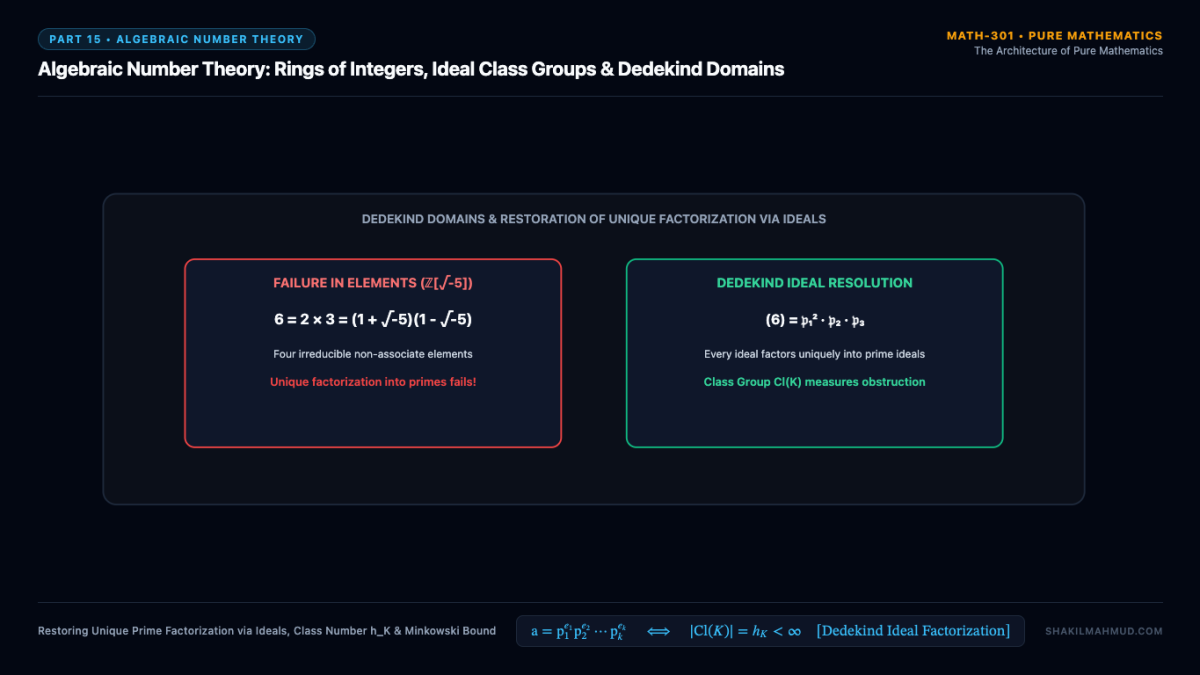
In the ring of ordinary integers $mathbb{Z}$, the Fundamental Theorem of Arithmetic guarantees that every number factors uniquely into prime elements. However, in the 19th century, when mathematicians attempted to prove Fermat’s Last Theorem by extending arithmetic to cyclotomic number rings $mathbb{Z}[zeta_p]$, they suffered a devastating shock: unique prime factorization fails. In $mathbb{Z}[sqrt{-5}]$, for example, $6 = 2 cdot 3 = (1 + sqrt{-5})(1 – sqrt{-5})$. To restore arithmetic order, Ernst Kummer and Richard Dedekind revolutionized algebra by replacing numbers with Ideals, establishing the architecture of Algebraic Number Theory.
1. Algebraic Number Fields & The Ring of Integers $mathcal{O}_K$
An Algebraic Number Field $K$ is a finite-degree field extension of the rational numbers: $[K : mathbb{Q}] = n < infty$. Every such field can be generated by a single primitive element: $K = mathbb{Q}(alpha)$.
An element $beta in K$ is an algebraic integer if it is the root of a monic polynomial with coefficients in $mathbb{Z}$:
P(x) = x^d + a_{d-1}x^{d-1} + dots + a_1 x + a_0 = 0, quad a_i in mathbb{Z}
The set of all algebraic integers in $K$ forms a ring, denoted $mathcal{O}_K$, called the Ring of Integers of $K$. It serves as the natural generalization of $mathbb{Z}$ within $K$, possessing an integral basis $mathcal{O}_K = mathbb{Z} omega_1 oplus dots oplus mathbb{Z} omega_n$.
2. Dedekind Domains & Unique Factorization of Ideals
Although individual elements in $mathcal{O}_K$ may fail to factor uniquely, Dedekind demonstrated that the ring of integers is always a Dedekind Domain, characterized by three properties:
- $mathcal{O}_K$ is Noetherian (every ideal is finitely generated).
- $mathcal{O}_K$ is integrally closed in its fraction field $K$.
- Every non-zero prime ideal is maximal (Krull dimension is 1).
In any Dedekind domain, the Fundamental Theorem of Arithmetic is resurrected at the level of ideals: Every non-zero proper ideal $I subset mathcal{O}_K$ factors uniquely into a product of prime ideals:
I = mathfrak{p}_1^{e_1} mathfrak{p}_2^{e_2} cdots mathfrak{p}_g^{e_g}
In the non-unique factorization example $6 = 2 cdot 3 = (1+sqrt{-5})(1-sqrt{-5})$, the principal ideals decompose into prime ideals $(2) = mathfrak{p}^2$, $(3) = mathfrak{q}_1 mathfrak{q}_2$, $(1+sqrt{-5}) = mathfrak{p} mathfrak{q}_1$, and $(1-sqrt{-5}) = mathfrak{p} mathfrak{q}_2$. Both element products represent the exact same prime ideal product $mathfrak{p}^2 mathfrak{q}_1 mathfrak{q}_2$.
3. The Ideal Class Group & Class Number
To measure the precise degree to which unique element factorization fails in $mathcal{O}_K$, Dedekind introduced the Ideal Class Group $text{Cl}_K$.
Let $mathcal{I}_K$ be the group of non-zero fractional ideals of $K$, and let $mathcal{P}_K$ be the subgroup of principal fractional ideals ($alpha mathcal{O}_K$ for $alpha in K^times$). The class group is the quotient:
text{Cl}_K equiv frac{mathcal{I}_K}{mathcal{P}_K}
Unique factorization holds in $mathcal{O}_K$ if and only if $text{Cl}_K$ is trivial ($text{Cl}_K = {1}$). In a celebrated result, Hermann Minkowski used convex geometry and his Lattice Point Theorem to prove that the Ideal Class Group is always finite. Its order is the Class Number $h_K = |text{Cl}_K|$. Kummer proved Fermat’s Last Theorem for all “regular primes”—primes that do not divide the class number of the cyclotomic field $mathbb{Q}(zeta_p)$.
4. Ramification, Inertia, and Splitting
When an ordinary prime $p in mathbb{Z}$ is extended to the ring of integers $mathcal{O}_K$, the principal ideal $p mathcal{O}_K$ factorizes into prime ideals of $mathcal{O}_K$:
p mathcal{O}_K = mathfrak{p}_1^{e_1} mathfrak{p}_2^{e_2} cdots mathfrak{p}_g^{e_g}
The exponents $e_i$ are ramification indices, and the field degrees $f_i = [mathcal{O}_K/mathfrak{p}_i : mathbb{Z}/pmathbb{Z}]$ are inertia degrees, satisfying the fundamental identity $sum_{i=1}^g e_i f_i = [K : mathbb{Q}] = n$. A prime is unramified ($e_i = 1$) for all primes not dividing the field discriminant $Delta_K$. This structural decomposition of primes constitutes the foundational data encoded in global Galois representations and the Langlands program.