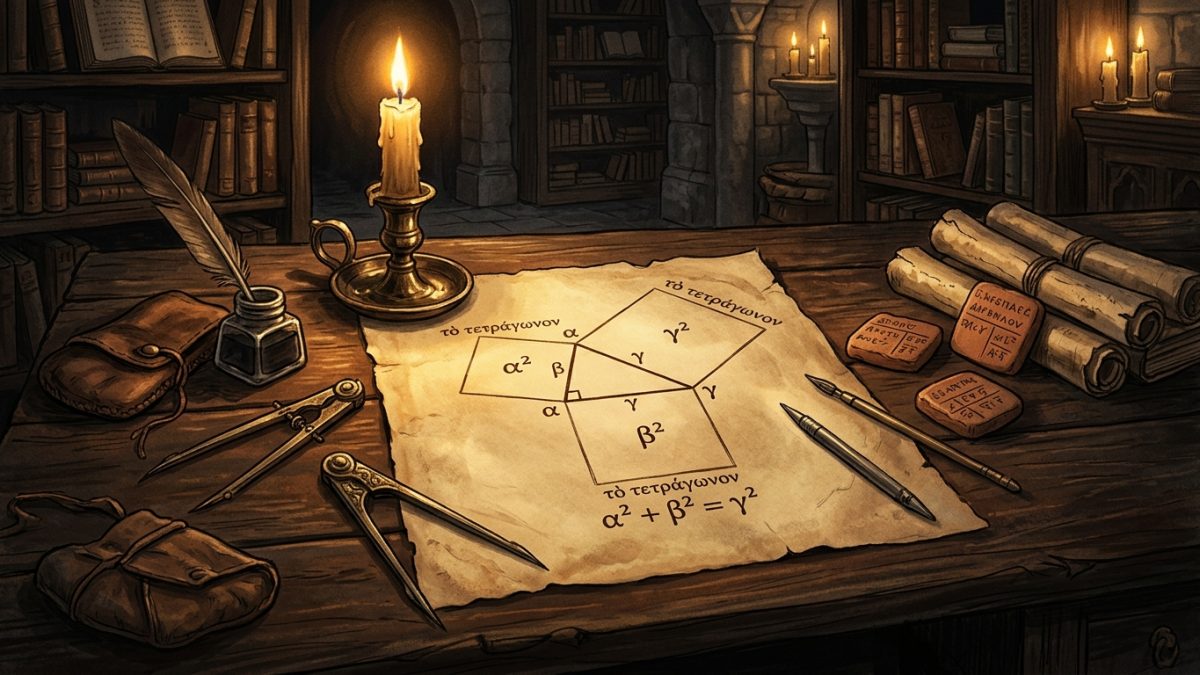
For over 350 years, Fermat’s Last Theorem ($x^n + y^n = z^n$ has no positive integer solutions for $n ge 3$) stood as mathematics’ most tantalizing enigma. Its eventual resolution by Andrew Wiles in 1995 required a conceptual revolution: bridging two seemingly disparate worlds of pure mathematics—the algebraic geometry of Elliptic Curves and the hyperbolic analysis of Modular Forms. This triumph confirmed the Shimura-Taniyama-Weil conjecture and cemented the Modularity Theorem as a cornerstone of modern number theory.
1. Elliptic Curves & The Chord-and-Tangent Group Law
An Elliptic Curve $E$ over a field $K$ (with characteristic not 2 or 3) is a non-singular projective cubic curve given by the Weierstrass equation:
y^2 = x^3 + a x + b, quad a, b in K, quad Delta equiv -16(4a^3 + 27b^2) neq 0
Together with a distinguished point at infinity $mathcal{O} = [0 : 1 : 0]$, the set of $K$-rational points $E(K)$ forms an abelian group under the geometric Chord-and-Tangent Law:
- To add two points $P$ and $Q$, draw the straight line through them. The cubic curve intersects this line at a unique third point $R$.
- Reflecting $R$ across the $x$-axis yields the sum: $P + Q = -R$.
- When $P = Q$, the line is taken to be the tangent to $E$ at $P$.
By the celebrated Mordell-Weil Theorem, for any number field $K$, the group of rational points is finitely generated: $E(K) cong mathbb{Z}^r oplus E(K)_{text{tors}}$, where $r$ is the algebraic rank and $E(K)_{text{tors}}$ is the finite torsion subgroup.
2. Modular Forms & The Hyperbolic Upper Half-Plane
A Modular Form of weight $k$ for the modular group $text{SL}(2, mathbb{Z})$ is a holomorphic function $f: mathbb{H} to mathbb{C}$ on the upper half-plane satisfying an extraordinary automorphic symmetry:
fleft(frac{a z + b}{c z + d}right) = (c z + d)^k f(z) quad forall begin{pmatrix} a & b \ c & d end{pmatrix} in text{SL}(2, mathbb{Z})
Because $begin{pmatrix} 1 & 1 \ 0 & 1 end{pmatrix} in text{SL}(2, mathbb{Z})$, $f(z + 1) = f(z)$, implying that $f$ admits a Fourier $q$-expansion with $q = e^{2pi i z}$:
f(z) = sum_{n=0}^infty a_n q^n = sum_{n=0}^infty a_n e^{2pi i n z}
If $a_0 = 0$, $f$ vanishes at the cusp $iinfty$ and is called a Cusp Form. The spaces of modular forms $M_k$ and cusp forms $S_k$ are finite-dimensional vector spaces endowed with an inner product (the Petersson inner product) and an algebra of commuting self-adjoint operators: the Hecke Operators $T_n$.
3. The L-Function of an Elliptic Curve
Given an elliptic curve $E$ over $mathbb{Q}$, we count its points modulo every prime $p$. Let $N_p$ be the number of points on $E$ over the finite field $mathbb{F}_p$. The arithmetic trace of Frobenius is $a_p equiv p + 1 – N_p$. By Hasse’s Theorem, $|a_p| le 2sqrt{p}$.
We assemble these local counts into the global Hasse-Weil L-Function of $E$:
L(E, s) equiv prod_{p mid Delta} left(1 – a_p p^{-s}right)^{-1} prod_{p nmid Delta} left(1 – a_p p^{-s} + p^{1-2s}right)^{-1} = sum_{n=1}^infty frac{a_n}{n^s}
Historically, it was unknown whether $L(E, s)$ possessed an analytic continuation beyond $text{Re}(s) > 3/2$.
4. The Modularity Theorem & The Resolution of Fermat
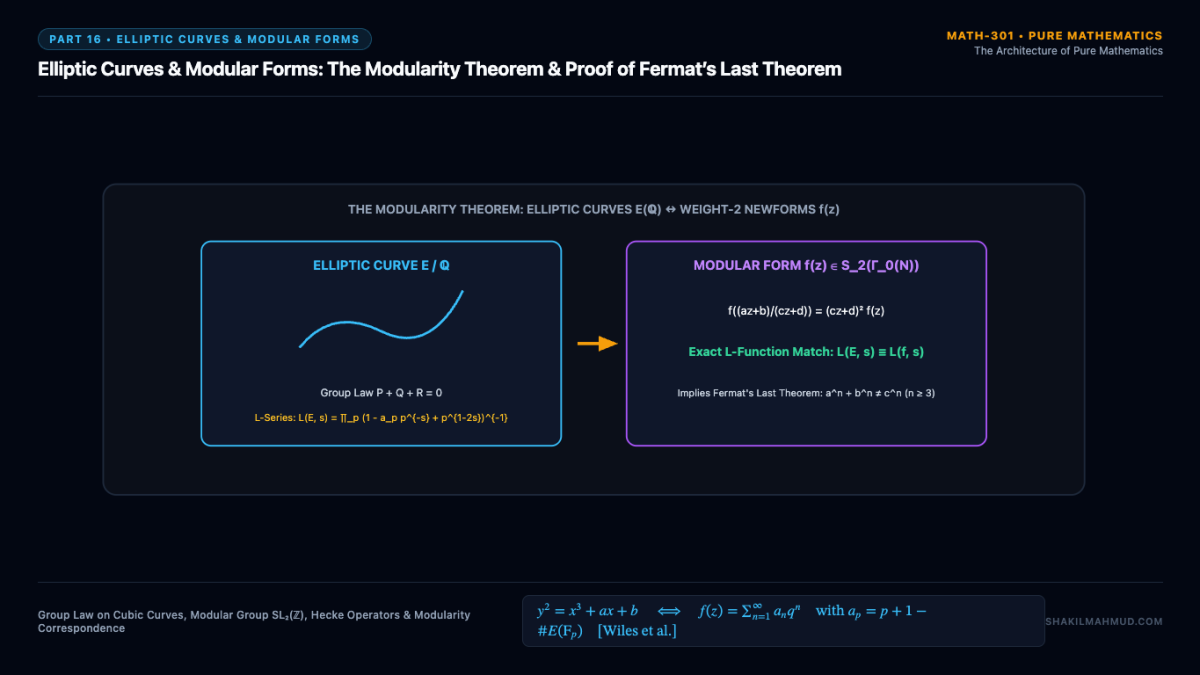
The Shimura-Taniyama-Weil Conjecture made the audacious claim that every elliptic curve over $mathbb{Q}$ is modular. More precisely, for every elliptic curve $E/mathbb{Q}$ of conductor $N$, there exists a weight-2 cusp form $f in S_2(Gamma_0(N))$ such that their Fourier and Dirichlet coefficients match prime-by-prime:
a_p(E) = a_p(f) quad forall p implies L(E, s) = L(f, s)
In the 1980s, Gerhard Frey observed that a non-trivial solution to Fermat’s equation $a^p + b^p = c^p$ would yield a hypothetical “Frey Curve”: $y^2 = x(x – a^p)(x + b^p)$. Jean-Pierre Serre conjectured and Ken Ribet proved that such a curve would be so bizarrely unramified that it could not possibly be modular.
In 1995, Andrew Wiles, assisted by Richard Taylor, proved the Modularity Theorem for semistable elliptic curves via a groundbreaking deformation theory of Galois representations ($R = T$ theorem). Because the Frey curve cannot be modular, it cannot exist; hence, Fermat’s Last Theorem was finally proven true.