For over three centuries, the greatest mathematicians in Europe sought a universal algebraic formula for the roots of quintic (degree-5) polynomials, generalizing the classical quadratic, cubic (Cardano), and quartic (Ferrari) formulas. In 1832, on the eve of a fatal duel at the age of twenty, Évariste Galois solved this ancient problem by inventing Galois Theory. By establishing an elegant dictionary between field extensions and symmetry groups, Galois proved that the general quintic equation is fundamentally unsolvable by radicals.
1. Field Extensions & Splitting Fields
A Field $F$ is a commutative ring in which every non-zero element has a multiplicative inverse. A field $E$ containing $F$ as a subfield is called a Field Extension, denoted $E/F$. The extension $E$ forms a natural vector space over $F$, whose dimension $[E : F] = dim_F(E)$ is the degree of the extension.
- An element $alpha in E$ is Algebraic over $F$ if it is the root of a non-zero polynomial $P(x) in F[x]$; otherwise, it is Transcendental (e.g., $pi$ and $e$ over $mathbb{Q}$).
- The Splitting Field of a polynomial $f(x) in F[x]$ is the smallest extension field $E$ over which $f(x)$ factors completely into linear factors: $f(x) = c prod_{i=1}^n (x – alpha_i)$.
2. The Galois Group of an Extension
An extension $E/F$ is a Galois Extension (normal and separable) if it is the splitting field of a family of separable polynomials. The Galois Group $text{Gal}(E/F)$ is the group of all field automorphisms of $E$ that fix every element of the base field $F$:
text{Gal}(E/F) equiv { sigma: E xrightarrow{sim} E mid sigma text{ is an isomorphism and } forall c in F, ; sigma(c) = c }
Because any automorphism $sigma in text{Gal}(E/F)$ must permute the roots of any polynomial with coefficients in $F$, the Galois group is naturally isomorphic to a subgroup of the symmetric group $S_n$ permuting the $n$ roots of the polynomial.
3. The Fundamental Theorem of Galois Theory
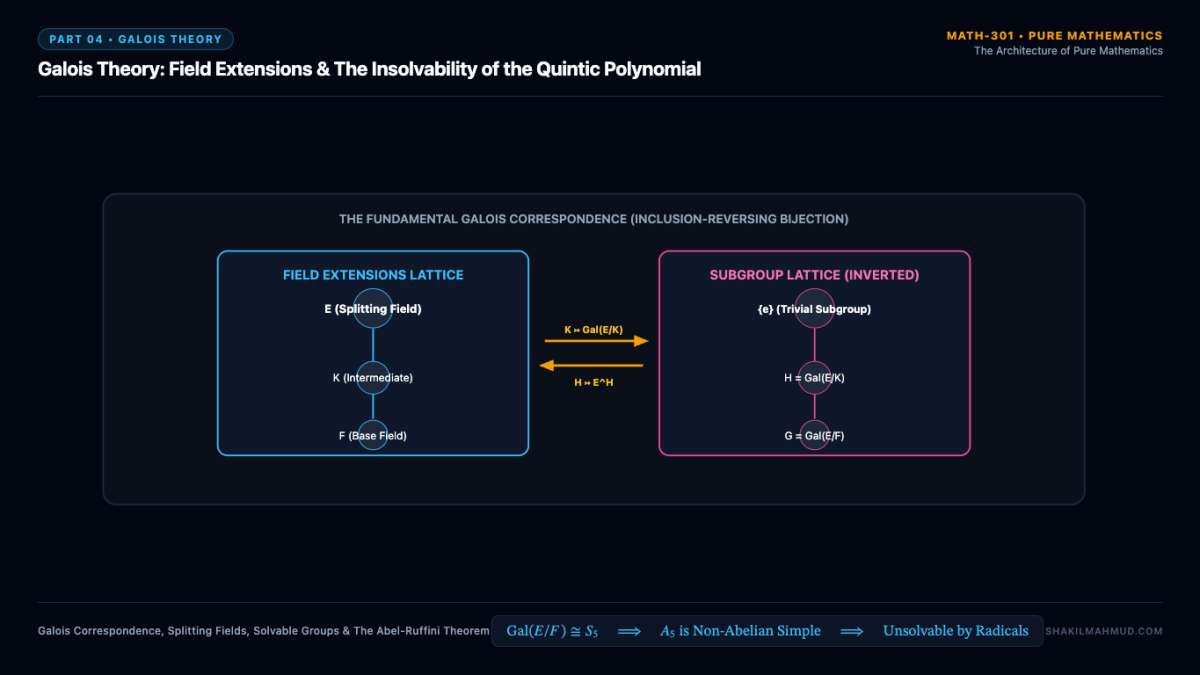
The crowning achievement of Galois theory is the establishment of an exact, inclusion-reversing bijection between intermediate fields $K$ ($F subseteq K subseteq E$) and subgroups $H le text{Gal}(E/F)$:
K longmapsto text{Gal}(E/K) = { sigma in text{Gal}(E/F) mid forall x in K, sigma(x) = x }
H longmapsto E^H = { x in E mid forall sigma in H, sigma(x) = x }
This correspondence possesses profound structural properties:
- Larger intermediate fields correspond to smaller subgroups: $[E : K] = |H|$ and $[K : F] = [text{Gal}(E/F) : H]$.
- An intermediate extension $K/F$ is itself a Galois extension if and only if $H = text{Gal}(E/K)$ is a Normal Subgroup ($H triangleleft text{Gal}(E/F)$). In that case, the Galois group of the sub-extension is the quotient group:
text{Gal}(K/F) cong text{Gal}(E/F) / text{Gal}(E/K)
4. Solvability by Radicals & The Insolvability of the Quintic
A polynomial equation $f(x) = 0$ is Solvable by Radicals (i.e., its roots can be expressed through finite additions, subtractions, multiplications, divisions, and $n$-th root extractions) if and only if its splitting field can be reached via a tower of radical extensions $F = K_0 subset K_1 subset dots subset K_m = E$ where each step adjoins a root: $K_{i+1} = K_i(sqrt[n_i]{a_i})$.
Galois proved the ultimate criterion: a polynomial is solvable by radicals if and only if its Galois group is a Solvable Group (possesses a subnormal series with abelian factor quotients):
{e} = G_k triangleleft G_{k-1} triangleleft dots triangleleft G_0 = G quad text{such that each } G_{i-1}/G_i text{ is cyclic}
For the general quintic polynomial ($n = 5$), the Galois group over $mathbb{Q}$ is the full symmetric group $S_5$. The only non-trivial normal subgroup of $S_5$ is the alternating group $A_5$ (of order 60). However, $A_5$ is a Simple Group: it contains no proper normal subgroups whatsoever, and because $A_5$ is non-abelian, its factor cannot be cyclic. Thus, $S_5$ is not a solvable group—proving the Abel-Ruffini Theorem: no algebraic formula using radicals can ever solve the general quintic equation.