Linear algebra is the universal language of modern mathematics. While introductory calculus presents vectors as coordinate arrows in $mathbb{R}^3$, abstract mathematics views a Vector Space as a module over an arbitrary field $F$—encompassing function spaces, quantum Hilbert states, and differential form complexes. By elevating linear maps to dual spaces $V^*$ and multilinear operations to Tensor Products $V otimes W$, linear algebra becomes the foundational engine of modern geometry and representation theory.
1. Vector Spaces over General Fields & The Hamel Basis
A vector space $V$ over an arbitrary field $F$ satisfies eight axioms of vector addition and scalar multiplication. By Zorn’s Lemma, every vector space possesses a Hamel Basis: a subset $mathcal{B} subset V$ such that every vector $v in V$ can be uniquely written as a finite linear combination:
v = sum_{i=1}^n c_i b_i, quad c_i in F, ; b_i in mathcal{B}
The cardinality $|mathcal{B}|$ is the invariant dimension $dim_F(V)$. For function spaces (such as $C^infty(mathbb{R})$), Hamel bases are uncountably infinite, distinguishing them from topological Schauder bases used in functional analysis.
2. Dual Spaces & The Bidual Canonical Embedding
Given a vector space $V$, its algebraic Dual Space $V^* equiv text{Hom}_F(V, F)$ is the vector space of all linear functionals $f: V to F$. When $V$ is finite-dimensional, $dim(V^*) = dim(V)$, making $V$ and $V^*$ isomorphic, though this isomorphism requires choosing a specific basis.
In contrast, there exists a strictly canonical, basis-independent evaluation embedding of $V$ into its double dual (the bidual) $V^{**} = (V^*)^*$, defined by:
text{ev}: V longrightarrow V^{**}, quad v longmapsto text{ev}_v quad text{where } text{ev}_v(f) equiv f(v)
For finite-dimensional spaces, $text{ev}$ is a natural isomorphism ($V cong V^{**}$), establishing that vectors and covectors are geometric duals of one another.
3. Canonical Decompositions: Spectral Theorem & Jordan Normal Form
The structure of a linear operator $T: V to V$ is classified by its canonical forms:
- The Spectral Theorem: If $V$ is an inner product space over $mathbb{C}$ and $T$ is normal ($T T^* = T^* T$), there exists an orthonormal basis of eigenvectors diagonalizing $T$:
V = bigoplus_{lambda in sigma(T)} E_lambda, quad T = sum_{lambda in sigma(T)} lambda P_lambda
- Jordan Canonical Form: Over an algebraically closed field, any operator $T$ decomposes uniquely into Jordan blocks $J_k(lambda) = lambda I + N$ where $N$ is nilpotent ($N^k = 0$), classifying linear transformations up to similarity.
4. The Universal Property of Tensor Products
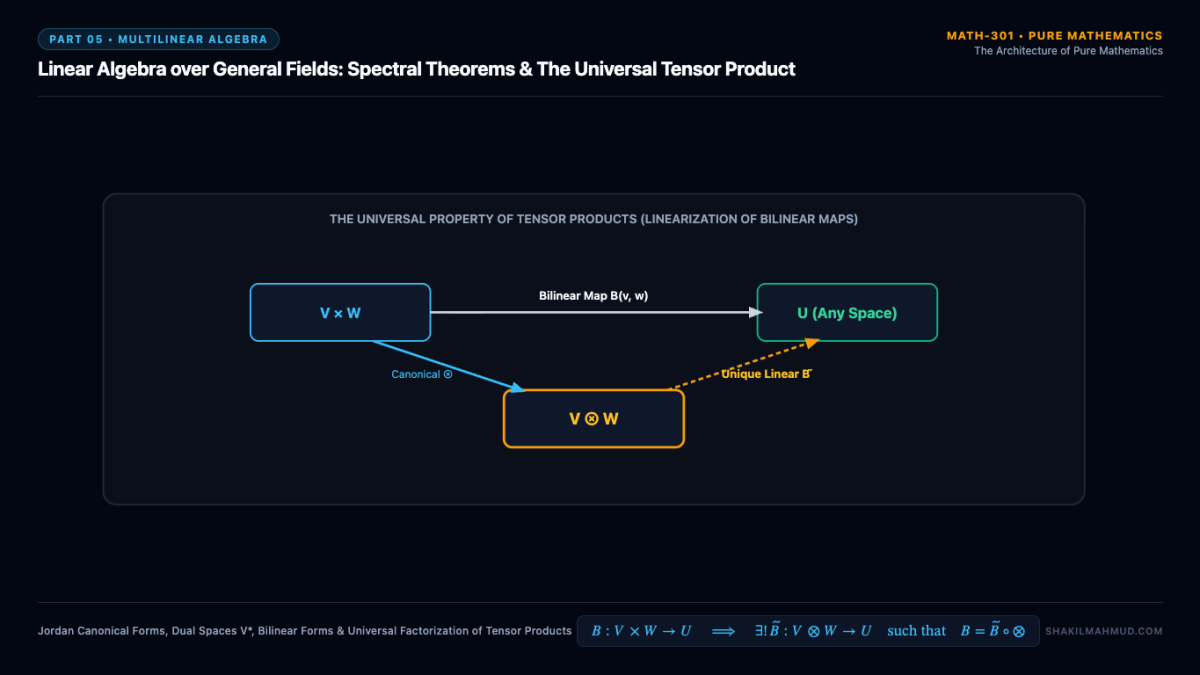
In multilinear algebra, evaluating bilinear maps $B: V times W to U$ is cumbersome because Cartesian products are non-linear: $B(v_1 + v_2, w) neq B(v_1, w) + B(v_2, w)$ in the vector space structure of $V times W$. The Tensor Product $V otimes W$ solves this dilemma by linearizing all multilinear maps.
Formally, $V otimes W$ is the unique vector space equipped with a canonical bilinear map $otimes: V times W to V otimes W$ satisfying the Universal Property: for every vector space $U$ and every bilinear map $B: V times W to U$, there exists a unique linear transformation $tilde{B}: V otimes W to U$ such that the diagram commutes:
B = tilde{B} circ otimes quad Longleftrightarrow quad B(v, w) = tilde{B}(v otimes w)
Constructed as the quotient of the free vector space $F(V times W)$ by the subspace of multilinear relations, the tensor product has dimension $dim(V otimes W) = dim(V) times dim(W)$, serving as the mathematical bedrock for metric tensors, curvature fields, and quantum entangled states.