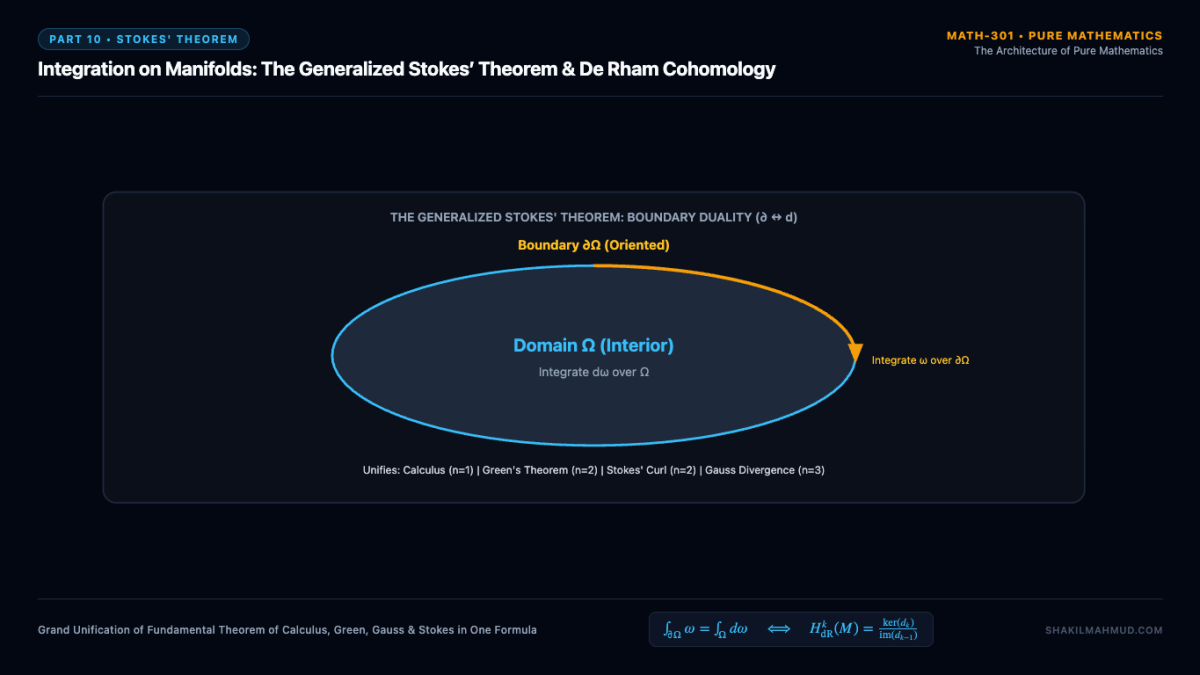
In vector calculus, Green’s Theorem, the Divergence Theorem, and the classical Kelvin-Stokes Theorem appear as three separate, computationally intricate formulas. Modern differential geometry reveals that these historical theorems are merely shadows of a single, breathtakingly elegant identity: The Generalized Stokes’ Theorem. Formulated entirely in the language of exterior calculus on oriented manifolds with boundary, this theorem bridges global topology and local differential analysis.
1. Orientability & Partitions of Unity
To integrate an $n$-form over an $n$-dimensional smooth manifold $M$, the manifold must be orientable: there must exist an atlas whose transition maps have strictly positive Jacobian determinants everywhere:
det left( frac{partial phi_beta^i}{partial phi_alpha^j} right) > 0 quad forall alpha, beta
Equivalently, an orientable manifold admits a non-vanishing volume form $omega in Omega^n(M)$.
To integrate forms with non-compact support across curved manifolds covered by multiple charts, mathematicians employ a Partition of Unity: a family of smooth bump functions ${rho_alpha}$ satisfying $0 le rho_alpha le 1$, $text{supp}(rho_alpha) subset U_alpha$, and $sum_alpha rho_alpha(p) = 1$ everywhere. The integral is defined coordinate-wise as:
int_M omega equiv sum_alpha int_{U_alpha} rho_alpha omega = sum_alpha int_{phi_alpha(U_alpha)} (phi_alpha^{-1})^*(rho_alpha omega)
2. Manifolds with Boundary & Induced Orientation
A smooth manifold with boundary $(M, partial M)$ is locally modeled on the half-space $mathbb{H}^n = {(x^1, dots, x^n) in mathbb{R}^n : x^n ge 0}$. The boundary $partial M$ is an $(n-1)$-dimensional smooth manifold without boundary.
Orientation on $M$ induces a canonical boundary orientation on $partial M$ via the “outward-pointing normal first” convention: if $(v_1, dots, v_{n-1})$ is an oriented frame on $T_p(partial M)$ and $N_p$ is an outward normal vector, then $(N_p, v_1, dots, v_{n-1})$ matches the orientation of $M$.
3. The Generalized Stokes’ Theorem
Let $M$ be a compact, oriented $n$-dimensional smooth manifold with boundary $partial M$, and let $omega in Omega^{n-1}(M)$ be a smooth differential $(n-1)$-form with compact support. Then:
int_{partial M} omega = int_M domega
The power of this formula lies in its universality:
- Fundamental Theorem of Calculus ($n=1$): $M = [a, b]$, $partial M = {b} – {a}$, $d f = f'(x) dx implies int_a^b f'(x) dx = f(b) – f(a)$.
- Green’s Theorem ($n=2$): $M subset mathbb{R}^2$, $omega = P dx + Q dy implies domega = left(frac{partial Q}{partial x} – frac{partial P}{partial y}right) dx wedge dy$.
- Classical Stokes’ Theorem ($n=2$ surface in $mathbb{R}^3$): Relates boundary loop circulation to surface curl flux.
- Gauss Divergence Theorem ($n=3$ volume): Relates surface flux to volume divergence integral.
4. De Rham Cohomology & Topology
The nilpotence of the exterior derivative ($d^2 = 0$) guarantees that the image of $d_{k-1}$ is contained within the kernel of $d_k$:
text{Im}(d_{k-1}) equiv B^k(M) subseteq text{Ker}(d_k) equiv Z^k(M)
Forms in $Z^k(M)$ are closed ($domega = 0$), while forms in $B^k(M)$ are exact ($omega = deta$). The $k$-th de Rham Cohomology Group is defined as the quotient space:
H_{text{dR}}^k(M) equiv frac{Z^k(M)}{B^k(M)} = frac{{text{closed } ktext{-forms}}}{{text{exact } ktext{-forms}}}
By de Rham’s Theorem, $H_{text{dR}}^k(M) cong H^k(M; mathbb{R})$, establishing an extraordinary isomorphism between pure analysis (differential equations $domega = 0$) and algebraic topology (singular cohomology cycles and topological holes).