Throughout mathematics, distinct fields exhibit eerie structural resonances: products in topology mirror direct products in group theory; kernel subspaces in linear algebra mirror kernel homomorphisms in ring theory. In 1945, Saunders Mac Lane and Samuel Eilenberg invented Category Theory to formalize these cross-disciplinary analogies. Often called “the mathematics of mathematics” (or “generalized abstract nonsense”), category theory shifts the foundational gaze from internal elements to the external network of relationships, or Morphisms.
1. Categories, Objects & Morphisms
A Category $mathcal{C}$ consists of:
- A class of Objects $text{Ob}(mathcal{C})$.
- For every pair of objects $A, B$, a class of Morphisms (arrows) $text{Hom}_{mathcal{C}}(A, B)$.
- A composition law $circ: text{Hom}(B, C) times text{Hom}(A, B) to text{Hom}(A, C)$ satisfying:
- Associativity: $h circ (g circ f) = (h circ g) circ f$.
- Identity: For every object $A$, there exists an identity morphism $1_A in text{Hom}(A, A)$ such that $f circ 1_A = f$ and $1_B circ f = f$.
Prototypical categories include $mathbf{Set}$ (sets and functions), $mathbf{Grp}$ (groups and homomorphisms), $mathbf{Vect}_F$ (vector spaces and linear maps), and $mathbf{Top}$ (topological spaces and continuous maps).
2. Functors & Natural Transformations
The principle of category theory is that whenever a mathematical structure is defined, one must define the structure-preserving mappings between them. Mappings between categories are Functors.
A covariant functor $F: mathcal{C} to mathcal{D}$ assigns to each object $X in mathcal{C}$ an object $F(X) in mathcal{D}$, and to each morphism $f: X to Y$ a morphism $F(f): F(X) to F(Y)$, preserving identities and compositions ($F(g circ f) = F(g) circ F(f)$). (A contravariant functor reverses arrows: $F(f): F(Y) to F(X)$).
Mappings between functors are Natural Transformations $eta: F Rightarrow G$. For every object $X in mathcal{C}$, $eta$ assigns a morphism $eta_X: F(X) to G(X)$ in $mathcal{D}$ such that for any arrow $f: X to Y$, the naturality square commutes:
G(f) circ eta_X = eta_Y circ F(f)
As Mac Lane famously remarked: “I didn’t invent categories to study objects, or functors to study categories; I invented categories and functors to study natural transformations.”
3. Universal Properties & Adjoint Functors
In category theory, objects are defined not by what they contain, but by how they interact with all other objects via Universal Properties. For instance, the Cartesian product $A times B$ is defined universally as an object equipped with projection arrows $pi_1, pi_2$ such that for any object $Z$ with arrows $f: Z to A$ and $g: Z to B$, there exists a unique arrow $langle f, g rangle: Z to A times B$ making the diagrams commute.
Two functors $F: mathcal{C} to mathcal{D}$ and $G: mathcal{D} to mathcal{C}$ form an Adjunction (denoted $F dashv G$, where $F$ is left adjoint to $G$) if there is a natural bijection between hom-sets:
text{Hom}_{mathcal{D}}(F(C), D) cong text{Hom}_{mathcal{C}}(C, G(D))
Adjunctions encapsulate the deepest symmetries of mathematics: Free functors are left adjoint to forgetful functors; tensor products $-otimes B$ are left adjoint to internal Hom functors $text{Hom}(B, -)$; and limits commute with right adjoints.
4. The Yoneda Lemma
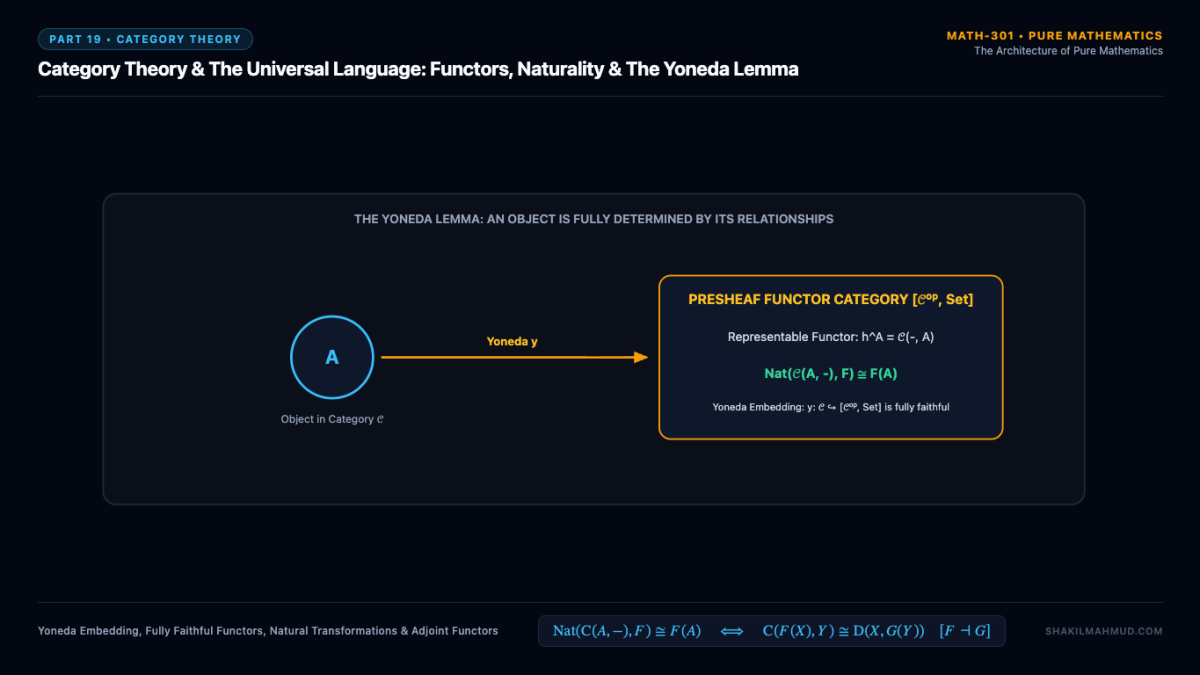
The philosophical pinnacle of category theory is the Yoneda Lemma. Let $mathcal{C}$ be a locally small category. For any object $A in mathcal{C}$, let $h^A equiv text{Hom}_{mathcal{C}}(A, -)$ be its covariant representable functor into $mathbf{Set}$.
The Yoneda Lemma asserts that for any functor $F: mathcal{C} to mathbf{Set}$, the set of natural transformations $text{Nat}(h^A, F)$ is in canonical one-to-one correspondence with the set $F(A)$:
text{Nat}(text{Hom}_{mathcal{C}}(A, -), F) cong F(A)
As a direct corollary (the Yoneda Embedding), the mapping $A mapsto h_A = text{Hom}(-, A)$ is a fully faithful embedding $mathcal{C} hookrightarrow mathbf{Set}^{mathcal{C}^{text{op}}}$. An object is completely and uniquely characterized by how every other object in the mathematical universe maps into it. In pure mathematics, an entity is nothing more or less than the totality of its relationships.