While real differentiability is a flexible local property, complex differentiability is extraordinarily rigid. A function $f: U subset mathbb{C} to mathbb{C}$ that is differentiable once in the complex sense is automatically infinitely differentiable ($C^infty$) and equal to its convergent Taylor series—a property known as Holomorphicity. Developed by Cauchy, Riemann, and Weierstrass, complex analysis reveals a profound duality between contour integrals, harmonic functions, and analytic continuation.
1. Complex Differentiability & The Cauchy-Riemann Equations
Let $U subset mathbb{C}$ be an open domain. A function $f(z) = u(x, y) + i v(x, y)$ (where $z = x + iy$) is holomorphic at $z_0$ if the limit exists:
f'(z_0) = lim_{Delta z to 0} frac{f(z_0 + Delta z) – f(z_0)}{Delta z}
Because $Delta z = Delta x + i Delta y$ can approach zero from any direction in the 2D plane, equating limits along the real and imaginary axes forces the real and imaginary components $u$ and $v$ to satisfy the Cauchy-Riemann Equations:
frac{partial u}{partial x} = frac{partial v}{partial y}, qquad frac{partial u}{partial y} = -frac{partial v}{partial x}
Equivalently, expressing $f$ in terms of Wirtinger derivatives $frac{partial}{partial bar{z}} equiv frac{1}{2}left(frac{partial}{partial x} + ifrac{partial}{partial y}right)$, holomorphicity simplifies to the coordinate-free condition $frac{partial f}{partial bar{z}} = 0$. Differentiating further reveals that both $u$ and $v$ are harmonic functions: $Delta u = Delta v = 0$.
2. Cauchy’s Integral Theorem & The Integral Formula
Complex integration along a piecewise smooth contour $gamma: [a, b] to mathbb{C}$ is defined by $int_gamma f(z) dz = int_a^b f(gamma(t)) gamma'(t) dt$.
By Green’s theorem and the Cauchy-Riemann equations, Cauchy’s Integral Theorem asserts that for any holomorphic function on a simply connected domain and any closed loop $gamma$:
oint_gamma f(z) dz = 0
This path-independence yields Cauchy’s Integral Formula, which reconstructs the internal values and all derivatives of a holomorphic function solely from its boundary values:
f(z_0) = frac{1}{2pi i} oint_gamma frac{f(z)}{z – z_0} dz, qquad f^{(n)}(z_0) = frac{n!}{2pi i} oint_gamma frac{f(z)}{(z – z_0)^{n+1}} dz
This striking result proves that once-differentiable complex functions are infinitely smooth and strictly analytic.
3. Rigidity Theorems: Liouville & The Maximum Modulus Principle
The global structure of holomorphic functions is tightly constrained:
- Liouville’s Theorem: Every bounded entire function ($f: mathbb{C} to mathbb{C}$ holomorphic on the whole plane) is constant. As an immediate corollary, this provides an elegant proof of the Fundamental Theorem of Algebra.
- The Maximum Modulus Principle: If $f$ is holomorphic on a connected domain $U$, $|f(z)|$ cannot achieve a local maximum in the interior of $U$ unless $f$ is constant.
- Identity Theorem: If two holomorphic functions coincide on a subset having an accumulation point in $U$, they are identical throughout $U$, enabling Analytic Continuation.
4. Laurent Series & The Residue Calculus
Near an isolated singularity $z_0$, a function admits a Laurent Series expanding in positive and negative powers:
f(z) = sum_{n=-infty}^infty a_n (z – z_0)^n, quad a_n = frac{1}{2pi i} oint_gamma frac{f(zeta)}{(zeta – z_0)^{n+1}} dzeta
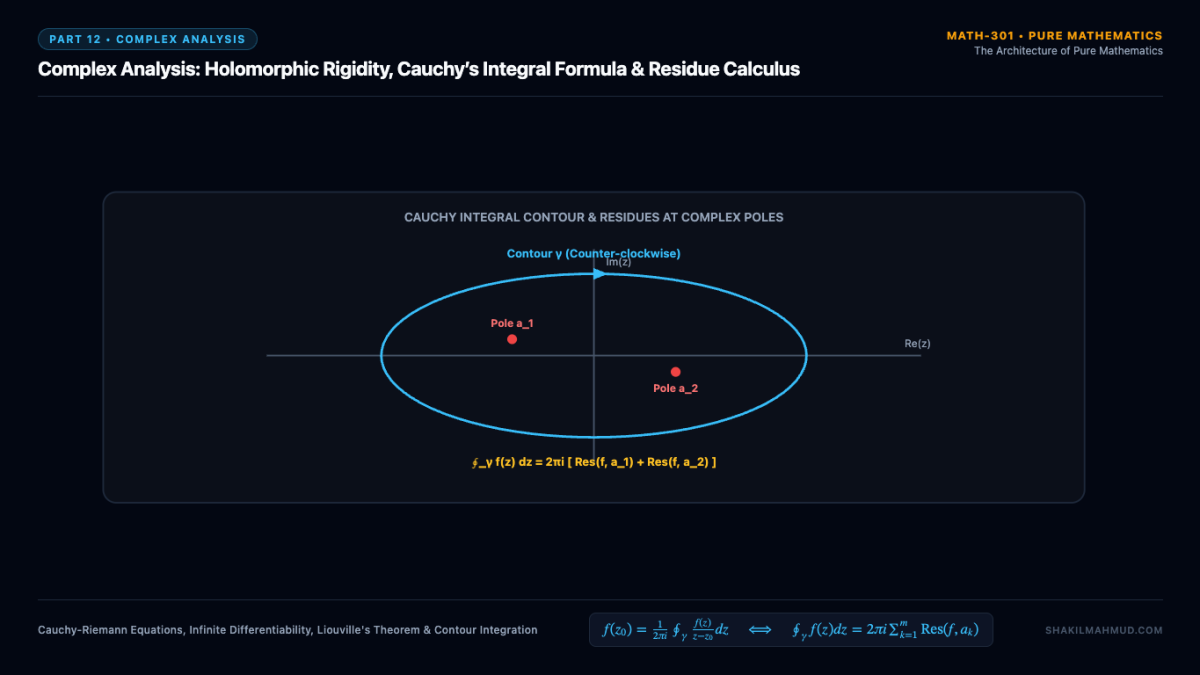
The coefficient $a_{-1}$ is called the Residue of $f$ at $z_0$, denoted $text{Res}(f, z_0)$. The Cauchy Residue Theorem evaluates complicated contour integrals by summing local residues:
oint_gamma f(z) dz = 2pi i sum_{k=1}^m text{Res}(f, z_k)
Residue calculus transforms difficult real integrals over $(-infty, infty)$—such as oscillatory Fourier integrals and quantum scattering amplitudes—into straightforward algebraic pole evaluations.