Prime numbers are the indivisible atoms of arithmetic, scattered across the positive integers with apparent irregularity. Yet underneath this pseudorandom distribution lies an astonishing analytical order. In 1859, in an eight-page masterpiece, Bernhard Riemann established that the discrete distribution of prime numbers is entirely controlled by the continuous, complex zeroes of a single analytic function: the Riemann Zeta Function $zeta(s)$. Analytic number theory harnesses contour integrals and complex analysis to solve deep questions of prime distribution.
1. The Euler Product & Dirichlet Series
For a complex variable $s = sigma + it$ with real part $sigma > 1$, the Riemann Zeta function is defined by the absolutely convergent Dirichlet series:
zeta(s) equiv sum_{n=1}^infty frac{1}{n^s}
In 1737, Leonhard Euler discovered that the Fundamental Theorem of Arithmetic translates into an infinite product over all prime numbers $p in mathbb{P}$:
zeta(s) = prod_{p in mathbb{P}} left( 1 – p^{-s} right)^{-1}
This identity establishes the golden bridge between arithmetic (the primes $p$) and analysis (the continuous sum over integers $n$).
2. Analytic Continuation & The Functional Equation
While the series diverges for $text{Re}(s) le 1$, Riemann used contour integration and the Jacobi Theta function to analytically continue $zeta(s)$ to a meromorphic function on the entire complex plane $mathbb{C}$, having only a single simple pole at $s = 1$ with residue $1$.
Furthermore, Riemann discovered that $zeta(s)$ satisfies a reflection symmetry across the critical line $text{Re}(s) = 1/2$, known as the Functional Equation:
zeta(s) = 2^s pi^{s-1} sinleft(frac{pi s}{2}right) Gamma(1 – s) zeta(1 – s)
The completed zeta function $xi(s) equiv frac{1}{2} s(s-1)pi^{-s/2}Gamma(s/2)zeta(s)$ is an entire function invariant under $s mapsto 1 – s$ ($xi(s) = xi(1-s)$).
3. The Prime Number Theorem & Non-Trivial Zeroes
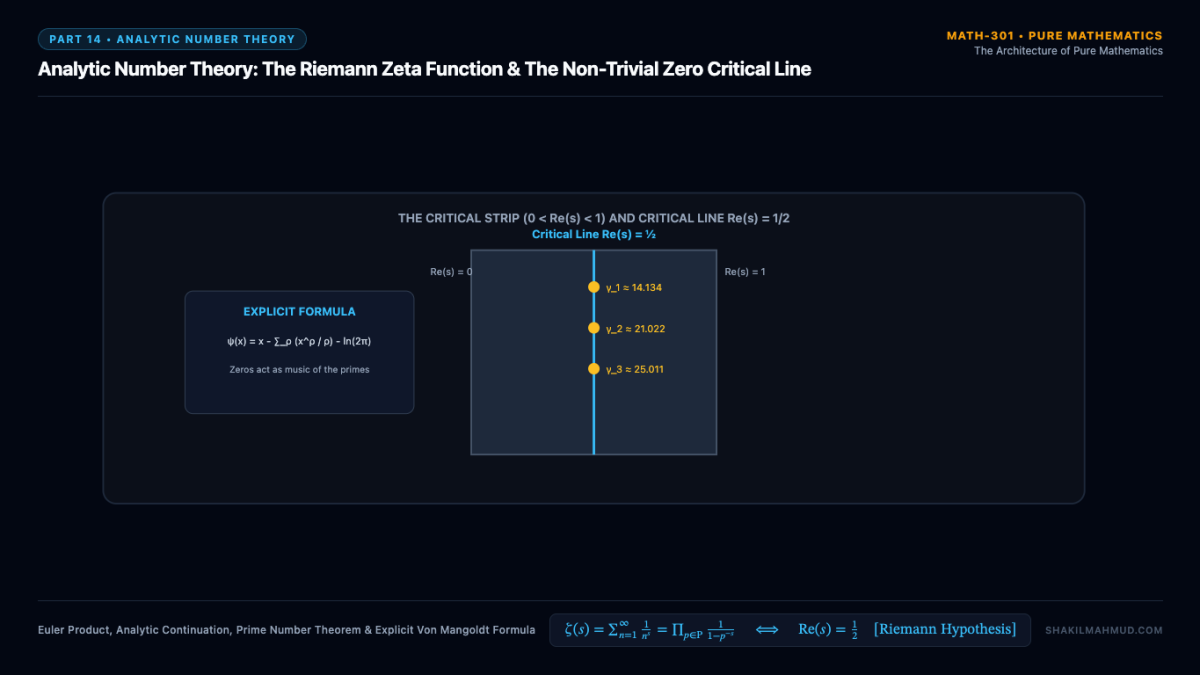
The functional equation reveals trivial zeroes at negative even integers: $s = -2, -4, -6, dots$. All remaining zeroes—the non-trivial zeroes—must reside in the critical strip $0 le text{Re}(s) le 1$.
The connection to prime counting is formalized by Chebyshev’s function $psi(x) = sum_{p^k le x} log p$. Riemann’s explicit formula represents the prime step-function as a smooth logarithmic integral plus an infinite superposition of oscillatory waves generated by the non-trivial zeroes $rho$:
psi(x) = x – sum_rho frac{x^rho}{rho} – log(2pi) – frac{1}{2}log(1 – x^{-2})
In 1896, Hadamard and de la Vallée Poussin independently proved that $zeta(s)$ has no zeroes on the boundary line $text{Re}(s) = 1$, which rigorously proved Gauss’s Prime Number Theorem:
pi(x) sim text{Li}(x) equiv int_2^x frac{dt}{log t} sim frac{x}{log x} quad text{as } x to infty
4. The Riemann Hypothesis & Quantum Chaos
The Riemann Hypothesis (RH) conjectures that all non-trivial zeroes lie precisely on the critical line:
text{Re}(rho) = frac{1}{2} quad Longleftrightarrow quad rho = frac{1}{2} + i gamma, quad gamma in mathbb{R}
RH guarantees the sharpest possible error bound on the distribution of primes: $|pi(x) – text{Li}(x)| le frac{1}{8pi} sqrt{x} log x$.
In modern mathematical physics, the Montgomery-Odlyzko law reveals that the local statistical correlations between high zeroes of $zeta(s)$ match the eigenvalue spacing of Gaussian Unitary Ensemble (GUE) random matrices from quantum chaos. This hints at the Hilbert-Pólya conjecture: the zeroes of the zeta function are eigenvalues of a self-adjoint quantum Hamiltonian whose operator nature remains the ultimate holy grail of modern mathematics.