A smooth manifold possesses topological cohesion and differential structure, yet it lacks any concept of length, angle, or distance. In 1854, Bernhard Riemann revolutionized mathematics by introducing an inner product on every tangent space, inventing Riemannian Geometry. This geometric architecture enables intrinsic measurement of curves, defines parallel transport across curved domains, and introduces the Riemann Curvature Tensor—the mathematical engine behind Einstein’s General Theory of Relativity.
1. The Riemannian Metric Tensor $g$
A Riemannian Metric on a smooth manifold $M$ is a smooth assignment of an inner product $g_p: T_p M times T_p M to mathbb{R}$ to each point $p in M$. It is symmetric ($g(X, Y) = g(Y, X)$) and positive-definite ($g(X, X) > 0$ for all $X neq 0$).
In local coordinates $(x^1, dots, x^n)$, the metric tensor is expressed as:
g = sum_{i,j=1}^n g_{ij} , dx^i otimes dx^j, quad g_{ij} equiv gleft(frac{partial}{partial x^i}, frac{partial}{partial x^j}right)
The metric induces an intrinsic distance function $d(p, q) = inf int_a^b sqrt{g(dot{gamma}(t), dot{gamma}(t))} dt$ over all piecewise smooth paths $gamma$, turning $(M, d)$ into a metric space whose topology coincides with $M$’s manifold topology.
2. Affine Connections & The Levi-Civita Connection
To differentiate a vector field along another vector field, a manifold requires a linear connection $nabla: Gamma(TM) times Gamma(TM) to Gamma(TM)$, denoted $(X, Y) mapsto nabla_X Y$.
By the Fundamental Theorem of Riemannian Geometry, on any Riemannian manifold $(M, g)$ there exists a unique affine connection $nabla$, known as the Levi-Civita Connection, satisfying two natural conditions:
- Metric Compatibility: $X(g(Y, Z)) = g(nabla_X Y, Z) + g(Y, nabla_X Z)$ (parallel transport preserves inner products).
- Torsion-Free: $T(X, Y) equiv nabla_X Y – nabla_Y X – [X, Y] = 0$.
The Christoffel symbols of the second kind $Gamma_{ij}^k$ are explicitly determined by the metric derivatives:
Gamma_{ij}^k = frac{1}{2} g^{kl} left( frac{partial g_{jl}}{partial x^i} + frac{partial g_{il}}{partial x^j} – frac{partial g_{ij}}{partial x^l} right)
3. Geodesic Motion & Completeness
A curve $gamma(t)$ is a geodesic if its tangent vector field $dot{gamma}(t)$ is parallel along itself: $nabla_{dot{gamma}} dot{gamma} = 0$. In local coordinates, this yields the non-linear geodesic differential equation:
frac{d^2 x^k}{dt^2} + sum_{i,j=1}^n Gamma_{ij}^k frac{dx^i}{dt} frac{dx^j}{dt} = 0
Geodesics represent curves of locally extremal length. By the Hopf-Rinow Theorem, for a connected Riemannian manifold, the following statements are equivalent:
- $(M, g)$ is geodesically complete (geodesics are defined for all $t in mathbb{R}$).
- $(M, d)$ is a complete metric space.
- Every closed and bounded subset is compact.
4. The Hierarchy of Curvature: Riemann, Ricci, and Scalar
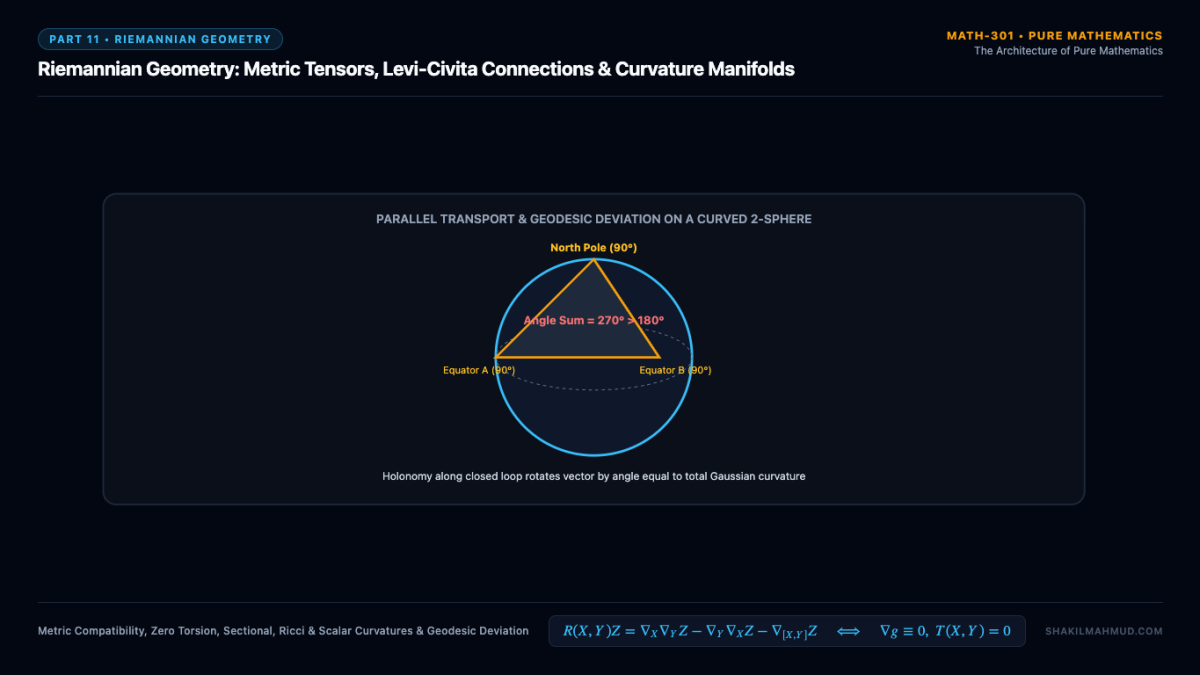
Curvature is the intrinsic obstruction to parallel transport being path-independent. The Riemann Curvature Endomorphism $R(X, Y)Z$ measures the commutator of covariant derivatives:
R(X, Y)Z equiv nabla_X nabla_Y Z – nabla_Y nabla_X Z – nabla_{[X, Y]} Z
In components, $R^rho_{;sigmamunu} = partial_mu Gamma^rho_{nusigma} – partial_nu Gamma^rho_{musigma} + Gamma^rho_{mulambda}Gamma^lambda_{nusigma} – Gamma^rho_{nulambda}Gamma^lambda_{musigma}$. Contracting indices yields the curvature hierarchy:
- Ricci Curvature Tensor: $R_{munu} equiv R^lambda_{;mulambdanu}$, measuring volume distortion along geodesics relative to Euclidean balls.
- Ricci Scalar: $R equiv g^{munu} R_{munu}$, capturing trace curvature at a single point.
- Einstein Tensor: $G_{munu} equiv R_{munu} – frac{1}{2} R g_{munu}$, which satisfies the contracted Bianchi identity $nabla^mu G_{munu} = 0$, forming the geometric foundation of general relativity.