Multivalued complex functions—such as the complex logarithm $log z$ or algebraic roots $sqrt{z}$—cannot live single-valued lives on the complex plane $mathbb{C}$. In his 1851 doctoral dissertation, Bernhard Riemann resolved this dilemma by introducing multi-sheeted topological surfaces on which branched functions become single-valued and holomorphic everywhere: Riemann Surfaces. As one-dimensional complex manifolds (or real two-dimensional conformal surfaces), Riemann surfaces reside at the intersection of algebraic geometry, hyperbolic topology, and string theory.
1. Definition & Complex Structures
A Riemann Surface $Sigma$ is a connected, Hausdorff, second-countable topological space equipped with a family of charts $(U_alpha, phi_alpha)$ mapping into $mathbb{C}$ such that the transition maps:
phi_beta circ phi_alpha^{-1}: phi_alpha(U_alpha cap U_beta) longrightarrow phi_beta(U_alpha cap U_beta)
are holomorphic diffeomorphisms (biholomorphisms). Because holomorphic maps preserve angles and orientation, a complex structure on a real 2D surface is strictly equivalent to an orientation together with a conformal structure (a Riemannian metric up to local scaling $g sim e^{2sigma} g$).
2. Divisors & The Riemann-Roch Theorem
On a compact Riemann surface $Sigma$, meromorphic functions are tightly governed by their zeroes and poles. A Divisor $D$ is a formal finite $mathbb{Z}$-linear combination of points: $D = sum_{p in Sigma} n_p cdot p$, with degree $deg(D) = sum n_p$.
The space of meromorphic functions whose poles are bounded by $D$ is denoted $L(D)$, with dimension $ell(D)$. The Riemann-Roch Theorem provides the exact balance between function spaces and topological genus $g$:
ell(D) – ell(K – D) = deg(D) – g + 1
where $K$ is the canonical divisor associated with holomorphic 1-forms. By bridging complex analysis ($ell(D)$) with topology ($g$), Riemann-Roch determines how algebraic curves can be holomorphically embedded into projective spaces $mathbb{CP}^n$.
3. The Uniformization Theorem
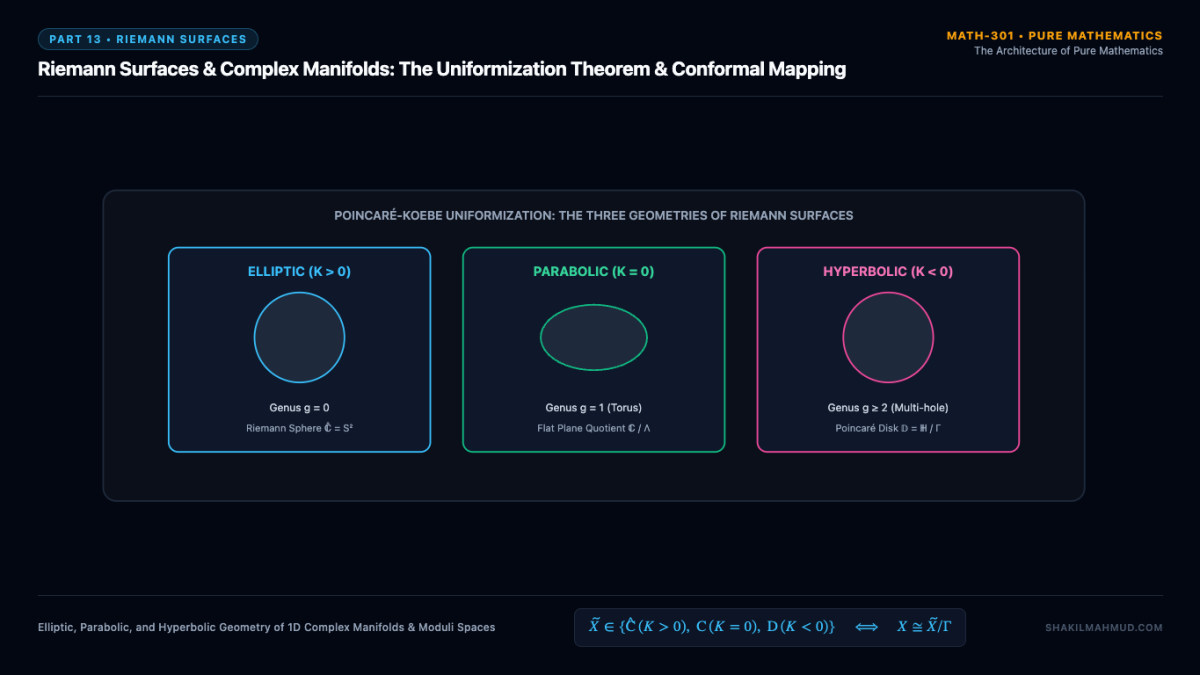
One of the most profound classification theorems in pure mathematics is the Poincaré-Koebe Uniformization Theorem. It asserts that every simply connected Riemann surface is biholomorphic to exactly one of three canonical model spaces:
- Elliptic Geometry ($g=0$): The Riemann Sphere $hat{mathbb{C}} = mathbb{CP}^1$ (positive Gaussian curvature, $+1$).
- Parabolic Geometry ($g=1$): The Complex Plane $mathbb{C}$ (zero Gaussian curvature, $0$).
- Hyperbolic Geometry ($g ge 2$): The Open Unit Disc $mathbb{D}$ or Upper Half-Plane $mathbb{H}$ (negative Gaussian curvature, $-1$).
Consequently, every compact Riemann surface of genus $g ge 2$ can be realized as a quotient $Sigma cong mathbb{H} / Gamma$, where $Gamma subset text{PSL}(2, mathbb{R})$ is a discrete, torsion-free Fuchsian group acting freely by hyperbolic isometries.
4. Moduli Spaces & Teichmüller Theory
While topologically all surfaces of genus $g$ are homeomorphic, they admit an uncountable continuum of inequivalent complex structures. The space classifying all conformal structures on a surface of genus $g$ up to diffeomorphism is the Moduli Space $mathcal{M}_g$.
The universal covering of $mathcal{M}_g$ is the Teichmüller Space $mathcal{T}_g$, which is homeomorphic to a ball of real dimension $6g – 6$ (for $g ge 2$). Governed by hyperbolic Fenchel-Nielsen coordinates and quadratic differentials, moduli spaces form the geometric foundation of 2D conformal field theory and the path-integral quantization of strings.