How can mathematics distinguish between a spherical football and a hollow donut? Intuitively, a donut possesses a hole through which a thread can pass, while a sphere does not. Yet point-set topology alone struggles to capture these higher-dimensional obstructions. In 1895, Henri Poincaré founded Algebraic Topology by inventing the Fundamental Group ($pi_1$): translating the qualitative geometric problem of 1-dimensional topological holes into the exact, computable structure of abstract group theory.
1. Homotopy Equivalence of Paths & Loops
Let $X$ be a topological space. A path is a continuous map $gamma: [0, 1] to X$. Two paths $gamma_0, gamma_1$ sharing the same endpoints ($x_0 = gamma(0), x_1 = gamma(1)$) are Homotopic ($gamma_0 simeq gamma_1$) if one can be continuously deformed into the other without moving the endpoints. Formally, there exists a continuous map $H: [0, 1] times [0, 1] to X$ such that:
H(s, 0) = gamma_0(s), quad H(s, 1) = gamma_1(s), quad H(0, t) = x_0, quad H(1, t) = x_1
Homotopy is an equivalence relation, partitioning the space of paths into homotopy classes $[gamma]$.
2. The Fundamental Group $pi_1(X, x_0)$
A Loop based at $x_0 in X$ is a path whose start and end points coincide: $gamma(0) = gamma(1) = x_0$. The set of homotopy classes of loops forms a group under the operation of path concatenation:
(gamma_1 * gamma_2)(s) = begin{cases} gamma_1(2s), & 0 le s le 1/2 \ gamma_2(2s – 1), & 1/2 le s le 1 end{cases}
Endowed with this operation, the set forms the Fundamental Group $pi_1(X, x_0)$:
- The identity element is the class of the constant loop $c_{x_0}(s) equiv x_0$.
- The inverse is the reversed path $gamma^{-1}(s) equiv gamma(1 – s)$.
- Associativity holds up to homotopy: $([gamma_1] * [gamma_2]) * [gamma_3] = [gamma_1] * ([gamma_2] * [gamma_3])$.
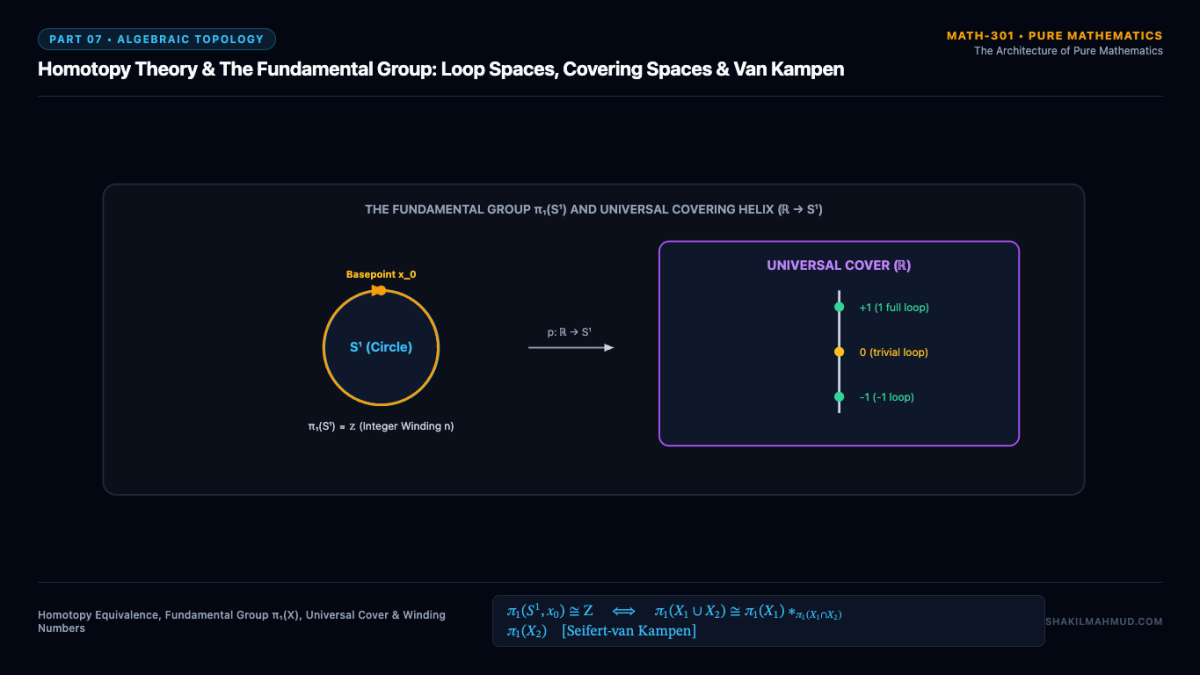
If $X$ is path-connected and $pi_1(X) cong {e}$ (trivial group), $X$ is Simply Connected. The 2-sphere $S^2$ is simply connected ($pi_1(S^2) = 0$), whereas the circle has $pi_1(S^1) cong mathbb{Z}$, indexed by the integer winding number counting how many times a loop wraps around the circle.
3. Covering Space Theory & The Universal Cover
The most rigorous method to compute fundamental groups is Covering Space Theory. A continuous surjective map $p: tilde{X} to X$ is a covering map if every point $x in X$ has an open neighborhood $U$ whose preimage $p^{-1}(U)$ is a disjoint union of open sheets homeomorphic to $U$.
For the circle $S^1$, its Universal Cover is the real line $mathbb{R}$, mapped via the exponential projection:
p: mathbb{R} longrightarrow S^1, quad t longmapsto e^{2pi i t}
By the Path Lifting Lemma, any loop $gamma$ in $S^1$ lifts to a unique path $tilde{gamma}$ in $mathbb{R}$ starting at $0$. The endpoint $tilde{gamma}(1) = n in mathbb{Z}$ is an integer: the winding number. Because $mathbb{R}$ is contractible ($pi_1(mathbb{R}) = 0$), the group of deck transformations of the cover is canonically isomorphic to the fundamental group: $text{Aut}(mathbb{R}/S^1) cong pi_1(S^1) cong mathbb{Z}$.
4. The Seifert-van Kampen Theorem
How do we compute the fundamental group of a complex space built from simpler pieces? The Seifert-van Kampen Theorem provides the master formula: if $X = U cup V$ where $U, V$ are open, path-connected subsets and $U cap V$ is path-connected, then $pi_1(X)$ is the free product of $pi_1(U)$ and $pi_1(V)$ amalgamated over $pi_1(U cap V)$:
pi_1(U cup V) cong pi_1(U) *_{pi_1(U cap V)} pi_1(V)
Using this algebraic engine, topologists compute the fundamental group of a figure-eight ($S^1 vee S^1$) as the free group on two generators $mathbb{Z} * mathbb{Z}$, and the 2-torus $T^2 = S^1 times S^1$ as the free abelian group $mathbb{Z} oplus mathbb{Z}$, demonstrating that loops in donuts commute while loops around separate holes do not.