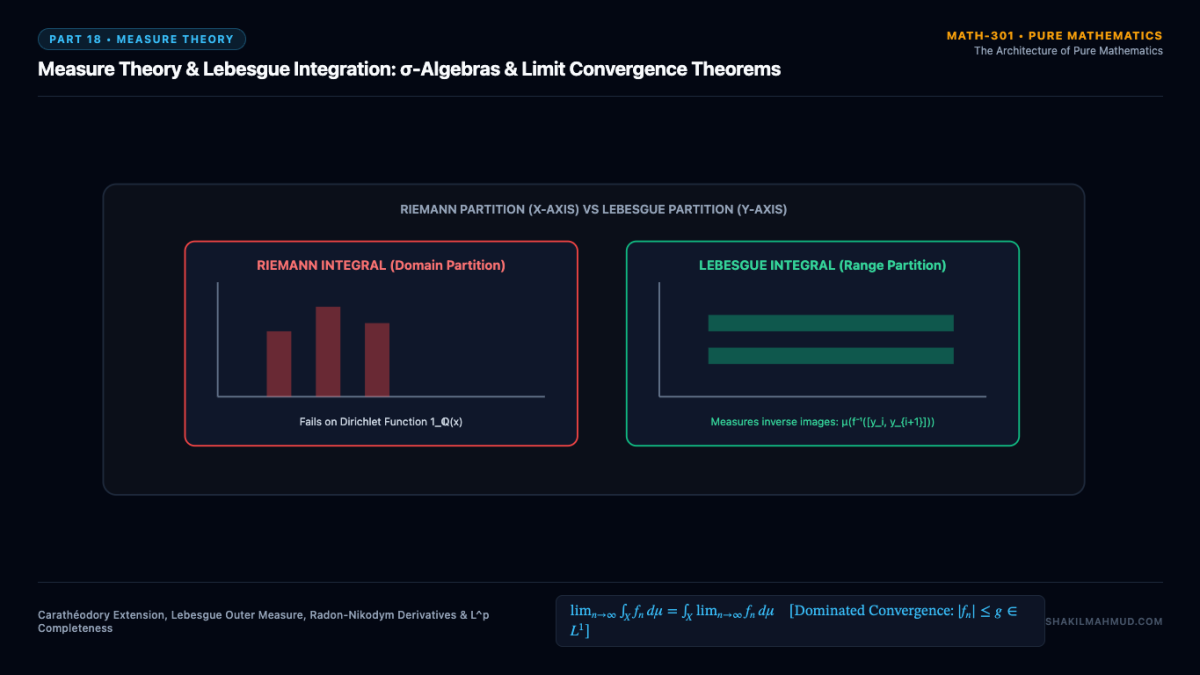
Riemannian integration—dividing a domain along the horizontal $x$-axis into thin vertical rectangles—is the workhorse of elementary calculus. However, under limit operations, the Riemann integral fails drastically: the pointwise limit of Riemann integrable functions is often not Riemann integrable, and function spaces like $C([a, b])$ are incomplete under the $L^1$ norm. In 1902, Henri Lebesgue transformed mathematical analysis by partitioning the vertical $y$-axis (the range) rather than the domain, creating Measure Theory and the Lebesgue Integral.
1. Non-Measurable Sets & $sigma$-Algebras
One might naively wish to assign a volume or “measure” to every subset of $mathbb{R}^n$ that is invariant under translations and rigid rotations. In 1905, Giuseppe Vitali proved using the Axiom of Choice that this is impossible: there exist subsets of $mathbb{R}$ that cannot be assigned any consistent measure without producing contradictions (the Vitali set; and later, the Banach-Tarski Paradox).
To avoid pathologies, measure must be restricted to a sub-collection of well-behaved sets called a $sigma$-Algebra $Sigma$ on a set $X$. A $sigma$-algebra satisfies three axioms:
- $X in Sigma$.
- $Sigma$ is closed under complements ($A in Sigma implies X setminus A in Sigma$).
- $Sigma$ is closed under countable unions ($A_n in Sigma implies bigcup_{n=1}^infty A_n in Sigma$).
The smallest $sigma$-algebra containing all open sets in a topological space is the Borel $sigma$-Algebra $mathcal{B}(X)$.
2. Measures & The Carathéodory Extension
A Measure on $(X, Sigma)$ is a function $mu: Sigma to [0, infty]$ satisfying $mu(emptyset) = 0$ and countable additivity: for any sequence of pairwise disjoint sets ${A_i}$,
muleft(bigcup_{i=1}^infty A_iright) = sum_{i=1}^infty mu(A_i)
The Lebesgue Measure $m$ on $mathbb{R}^n$ is constructed from elementary box volumes via Carathéodory’s Extension Theorem. It is the unique translation-invariant Borel measure that assigns to every unit hypercube a measure of $1$.
3. The Lebesgue Integral & Powerful Convergence Theorems
A function $f: X to mathbb{R}$ is measurable if pre-images of open sets are measurable ($f^{-1}(U) in Sigma$). The Lebesgue integral is constructed from non-negative simple functions $s = sum c_i chi_{A_i}$ where $int s , dmu = sum c_i mu(A_i)$, and taking the supremum:
int_X f , dmu equiv sup left{ int_X s , dmu : 0 le s le f, ; s text{ simple} right}
The supreme advantage of the Lebesgue integral over Riemann’s is its flawless interchange with infinite limits:
- Fatou’s Lemma: $int_X liminf_{n to infty} f_n , dmu le liminf_{n to infty} int_X f_n , dmu$.
- Monotone Convergence Theorem: If $0 le f_1 le f_2 le dots$ and $f_n to f$ pointwise, then $lim_{n to infty} int f_n , dmu = int f , dmu$.
- Lebesgue Dominated Convergence Theorem (DCT): If $f_n to f$ pointwise almost everywhere and $|f_n(x)| le g(x)$ for all $n$ with $int g , dmu < infty$, then:
lim_{n to infty} int_X f_n , dmu = int_X f , dmu
4. Absolute Continuity & The Radon-Nikodym Theorem
Given two measures $mu$ and $nu$ on $(X, Sigma)$, $nu$ is absolutely continuous with respect to $mu$ (denoted $nu ll mu$) if $mu(A) = 0 implies nu(A) = 0$ for all $A in Sigma$.
The Radon-Nikodym Theorem proves that whenever $nu ll mu$ (for $sigma$-finite measures), there exists a non-negative measurable function $h in L^1(mu)$, unique up to sets of measure zero, such that:
nu(A) = int_A h , dmu quad forall A in Sigma
The density $h = frac{dnu}{dmu}$ is the Radon-Nikodym derivative. In modern probability theory, Kolmogorov grounded all of probability upon measure spaces $(Omega, mathcal{F}, P)$, where random variables are measurable functions, expectations are Lebesgue integrals, and conditional expectations are Radon-Nikodym derivatives.