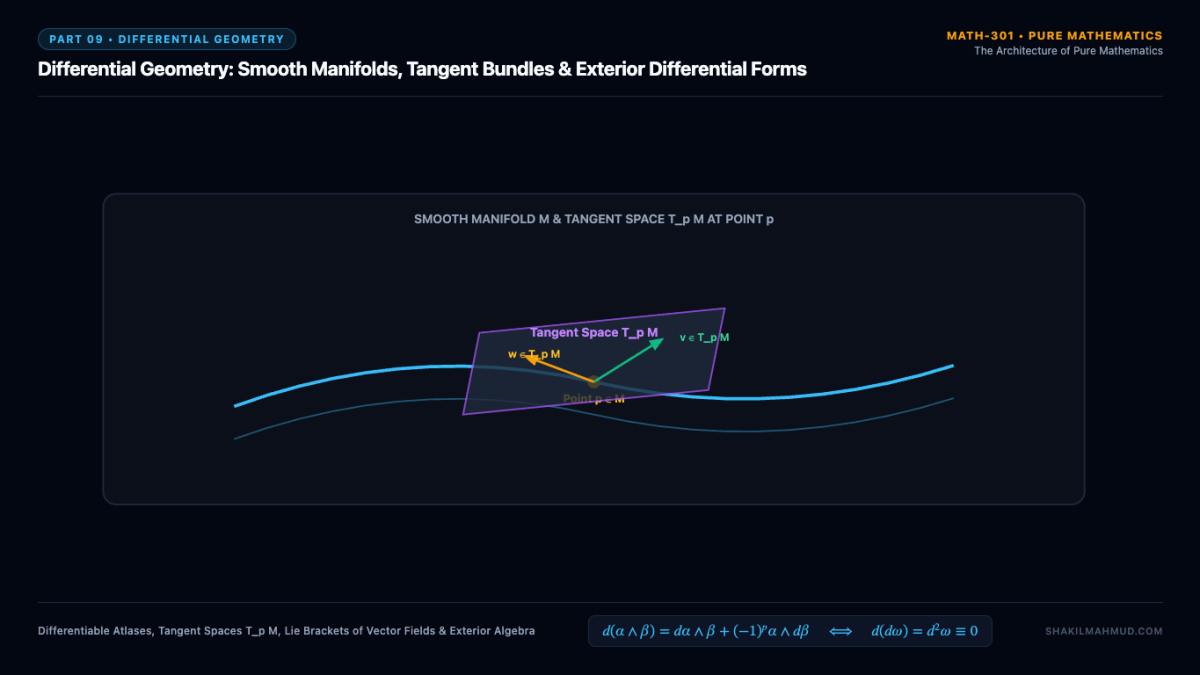
Classical calculus operates within the rigid confines of flat Euclidean space $mathbb{R}^n$. However, physical reality—from general relativistic spacetime to classical phase spaces—unfolds across curved topological structures known as Smooth Manifolds. By equipping topological spaces with coordinate charts that transition smoothly via $C^infty$-diffeomorphisms, differential geometry constructs an intrinsic framework where derivatives, vector fields, and tensors thrive without referencing any external embedding space.
1. Topological Manifolds & Smooth Atlases
An $n$-dimensional topological manifold $M$ is a second-countable, Hausdorff topological space locally homeomorphic to $mathbb{R}^n$. A coordinate chart is a pair $(U, phi)$ where $U subset M$ is open and $phi: U to phi(U) subset mathbb{R}^n$ is a homeomorphism.
Two charts $(U_alpha, phi_alpha)$ and $(U_beta, phi_beta)$ are $C^infty$-compatible if the transition map:
phi_beta circ phi_alpha^{-1}: phi_alpha(U_alpha cap U_beta) longrightarrow phi_beta(U_alpha cap U_beta)
is a diffeomorphism between open subsets of $mathbb{R}^n$. A collection of compatible charts covering $M$ forms a smooth atlas. A maximal atlas defines the smooth structure of $M$.
2. Derivations & The Tangent Space $T_p M$
Because there are no vectors pointing “outside” an abstract manifold, tangent vectors at $p in M$ are defined algebraically as derivations on the algebra of smooth germ functions $C^infty(p)$. A tangent vector $v in T_p M$ is a linear mapping $v: C^infty(p) to mathbb{R}$ satisfying the Leibniz product rule:
v(f cdot g) = f(p) v(g) + g(p) v(f)
In local coordinates $(x^1, dots, x^n)$, the partial derivative operators form a canonical basis for the $n$-dimensional tangent space $T_p M$:
T_p M = text{span}left{ left. frac{partial}{partial x^1} right|_p, dots, left. frac{partial}{partial x^n} right|_p right}
The disjoint union of all tangent spaces forms the Tangent Bundle $TM = bigsqcup_{p in M} T_p M$, a smooth manifold of dimension $2n$.
3. Vector Fields & The Lie Bracket
A vector field $X$ is a smooth section of the tangent bundle, $X in Gamma(TM)$, mapping each point $p mapsto X_p in T_p M$. While the composition of two vector fields as differential operators $X circ Y$ is second-order and hence not a derivation, their commutator defines the Lie Bracket:
[X, Y] equiv X circ Y – Y circ X
The Lie bracket satisfies bilinearity, antisymmetry ($[X, Y] = -[Y, X]$), and the Jacobi identity:
[X, [Y, Z]] + [Y, [Z, X]] + [Z, [X, Y]] = 0
Geometrically, $[X, Y]$ measures the failure of the integral flows generated by $X$ and $Y$ to commute, serving as the foundational operator in Lie theory and Frobenius’ theorem of foliation integrability.
4. Cotangent Bundles & The Exterior Algebra of Differential Forms
The dual of the tangent space is the cotangent space $T_p^* M$, spanned by the coordinate differentials ${dx^1, dots, dx^n}$. Elements of the exterior power $Omega^k(M) equiv Gamma(bigwedge^k T^* M)$ are differential $k$-forms. They are alternating multilinear tensors combined via the wedge product $wedge$:
omega wedge eta = (-1)^{k l} eta wedge omega quad text{for } omega in Omega^k(M), ; eta in Omega^l(M)
The exterior derivative $d: Omega^k(M) to Omega^{k+1}(M)$ is the unique antiderivation extending the differential of functions ($df = sum frac{partial f}{partial x^i} dx^i$) such that $d(domega) = d^2omega = 0$. This nilpotence ($d^2 = 0$) lays the foundation for de Rham cohomology and unified field theories.