While the fundamental group $pi_1(X)$ brilliantly detects 1-dimensional loops, it has severe limitations: it is often non-abelian (making it computationally intractable), and it completely ignores higher-dimensional topological cavities (such as the interior void of a hollow sphere). To classify holes across arbitrary dimensions, algebraic topology constructed Homology and Cohomology Theories—an abelian algebraic machine based on chain complexes that translates the topological boundaries of spaces into linear algebra.
1. Chain Complexes & The Nilpotent Boundary Operator
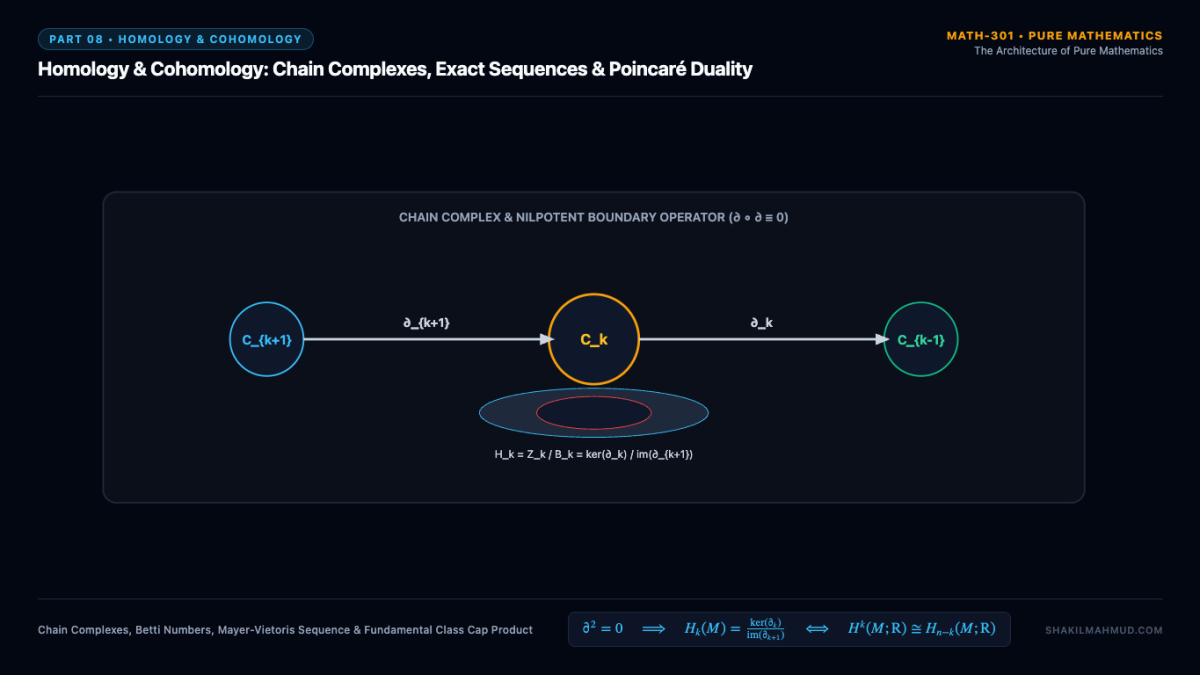
The foundation of all homology theories is the geometric fact that the boundary of a boundary is identically empty: $partial circ partial equiv 0$. In singular homology, this principle is formalized via a Chain Complex $(C_bullet, partial_bullet)$:
dots xrightarrow{partial_{k+2}} C_{k+1} xrightarrow{partial_{k+1}} C_k xrightarrow{partial_k} C_{k-1} xrightarrow{partial_{k-1}} dots xrightarrow{partial_1} C_0 xrightarrow{partial_0} 0
Where $C_k(X)$ is the free abelian group generated by all singular $k$-simplices $sigma: Delta^k to X$, and the boundary homomorphism $partial_k: C_k to C_{k-1}$ is defined by alternating face sums:
partial_k(sigma) = sum_{i=0}^k (-1)^i sigma|_{[v_0, dots, hat{v}_i, dots, v_k]}
A direct calculation confirms the fundamental nilpotency relation: $partial_k circ partial_{k+1} equiv 0$.
2. Cycles, Boundaries & The Homology Groups $H_k(X)$
Because $partial^2 = 0$, every boundary is automatically closed. We define two fundamental subgroups of $C_k$:
- The Group of $k$-Cycles: $Z_k equiv ker(partial_k)$ (chains with zero boundary, $partial c = 0$).
- The Group of $k$-Boundaries: $B_k equiv text{im}(partial_{k+1})$ (chains that are boundaries of $(k+1)$-chains).
Because $partial^2 = 0$, $B_k subseteq Z_k$. The $k$-th Singular Homology Group is the quotient group of cycles modulo boundaries:
H_k(X) equiv frac{Z_k(X)}{B_k(X)} = frac{ker(partial_k)}{text{im}(partial_{k+1})}
Homology groups are always abelian! Two cycles represent the same homology class if they differ by an enclosed boundary ($c_1 – c_2 = partial d$). The rank of $H_k(X)$ is the $k$-th Betti Number $b_k equiv text{rank}(H_k(X))$, which counts the number of independent $k$-dimensional holes.
3. Cohomology & The Cup Product Ring
Applying the $text{Hom}(-, G)$ functor to a chain complex dualizes the arrows, producing a Cochain Complex $(C^bullet, d^bullet)$ with coboundary operator $d_k equiv partial_{k+1}^*$ satisfying $d^2 = 0$:
H^k(X; G) equiv frac{ker(d_k)}{text{im}(d_{k-1})}
While homology groups are merely graded abelian groups, cohomology possesses an additional, extraordinarily rich algebraic structure: the Cup Product:
cup: H^p(X; R) times H^q(X; R) longrightarrow H^{p+q}(X; R)
The cup product turns the direct sum $H^*(X; R) = bigoplus_{k} H^k(X; R)$ into an associative, graded-commutative Cohomology Ring ($alpha cup beta = (-1)^{pq} beta cup alpha$). The cohomology ring can distinguish topological spaces whose homology groups are identical (such as $S^2 vee S^4$ versus the complex projective plane $mathbb{C}P^2$).
4. Poincaré Duality: The Symmetry of Manifolds
For an arbitrary topological space, homology groups in different dimensions are completely unrelated. However, if $M$ is a compact, oriented smooth $n$-dimensional manifold without boundary, its global topology exhibits a breathtaking symmetry: Poincaré Duality.
Given the fundamental orientation homology class $[M] in H_n(M; mathbb{Z})$, the cap product with $[M]$ establishes a canonical isomorphism between cohomology and homology across complementary dimensions:
D: H^k(M; mathbb{Z}) xrightarrow{quad cap [M] quad} H_{n-k}(M; mathbb{Z}) quad text{for all } 0 le k le n
As an immediate consequence, the Betti numbers of an orientable manifold are symmetric: $b_k = b_{n-k}$. For any compact 3-manifold, $b_0 = b_3 = 1$ and $b_1 = b_2$. Poincaré duality reveals that $k$-dimensional cycles intersect $(n-k)$-dimensional cycles transversally in a single point, establishing an eternal bridge between topology, geometry, and differential analysis.